Posted by Deborah Huso on Jan 22, 2012 in
Men,
Relationships It started as these conversations often do—about half a dozen women (this time a gathering mostly of writers and editors) circled around a table, satiated from an over large dinner they never would have gulped down with such relish in front of their husbands and boyfriends, ever so perfectly relaxed after two glasses of wine each, some starting on the third. And while the topic of men can hardly be avoided at a table of women (men are one of our favorite subjects, you know), there is something especially dangerous about a table full of women writers accompanied by wine.
It began innocently enough. The oldest among us, a talkative brunette from Alabama, mid-50s, was addressing the subject of the life changing effects of serious illness. “When I had cancer, it was the first time in my life my husband really took care of me, really worried about me.” She paused, bit her lip. “He was scared. It was really nice.”
We were not shocked by this. We nodded. We understood exactly the phenomenon of the unappreciated wife, taken for granted like a La-Z-Boy recliner or Monday night football. One among us asked, “How long have you been married?”
“30 years,” the Alabama writer replied.
Some of us gasped.
“It hasn’t been easy,” she went on. “There were many times I thought of leaving him, just wanted to give up.”
“Then how did you stay married 30 years?” I asked, leaning in for her imminent wisdom.
“The way you avoid divorce for 30 years,” she said, “is to stay married. It will eventually get better.”
Yes, I thought to myself, all you have to do is acquire some frightening and potentially fatal disease. Then your husband will suddenly appreciate you.
“You know,” the middle-aged brunette continued a bit wistfully, “I always dreamed of having a man who would listen to my problems and be there for me.”
A couple of us shot her hard and disbelieving looks. Really? She’s over 50, and she still holds onto this pipe dream?
The outdoors editor from Mississippi with her deadpan, never crack a smile humor (if indeed it was humor) said suddenly and firmly, “The guy who will listen to your problems and be there for you—that’s your dad.”
We all nodded vigorously in agreement, and the ever hopeful cancer survivor looked a little bit disappointed, perhaps wondering if her husband’s newfound love and admiration would dissipate like her cancer cells after chemo.
One can’t be too critical of her, however. Even the most experienced, cynical, and worn out wife among us cannot help but admit that occasionally we do dream of the perfect man. Why do housewives read Harlequin romances? Why do the more worldly seek Jane Austen? Because on some level, we still want to believe in those ridiculous fairytale romances of our youth, nevermind that every time my daughter tells me she wants to be Cinderella or Snow White, I cringe.
What we have to realize, however, ladies, is that the perfect man does not exist, at least not in one person. But you have a couple of choices for addressing this problem. You can accept that he does not exist and settle for one of the five or so types of men available, or you can complicate your life extremely (or maybe make it better—who knows?) by finding different men to fulfill your five different needs.
At the risk of over-generalizing (and I’m sure my male friends and colleagues will set me straight on this, as they always do), here’s what’s out there:
1) The Man’s Man
The benefits: He can change the oil in your car, catch dinner with a fishing pole or shoot it, too, if need be (just in case the apocalypse comes), and he can carry all your luggage on vacation (though, be advised, because he is a “man’s man,” he will complain about it loudly). Whatever is broken, he can fix it (except your heart, I’m afraid to report). And while he doesn’t do laundry, he’s a powerhouse at yard work, home repair, vehicle maintenance, and generally pretty good as well at holding his alcohol.
The drawbacks: Monday night football or some other equally annoying habit that leaves you wondering why he prefers pigskin to yours. Rough hands and a complete lack of foreplay awareness. Zero help around the house and substantial contributions to your workload—i.e., he drops double the number of stinky socks on the floor than the other four male types. He can boil water, but that’s about it when it comes to helping in the kitchen. He’ll do dishes if you promise him “you know what” afterwards.
Advice from the experts: Don’t marry a man just because he can fix your car; you can always hire someone to do this.
2) The Sugar Daddy
The benefits: If living in the lap of luxury is your highest priority, this is the man for you. He will give you everything your heart desires—a beautiful house, a luxury car, vacations to exotic and expensive destinations, all the clothes, jewelry, and shoes(!) you could desire. He will make you feel like a queen (albeit a lonely one).
The drawbacks: To finance all this luxury generally requires long hours, lots of traveling, and very little interaction with the life at home. He will be an absentee lover, husband, and father.
Advice from the experts: If you go this route, make sure you have a “rabbit” and/or a pool boy handy.
3) The Helpmate
The benefits: On first glance, this guy seems like a dream come true. He knows how to cook (in fact, he might even be a gourmet chef!), he does his own laundry and yours, too (and he even knows to wash your silk panties on the cold and delicate cycle). He’ll help you clean the house, professing to be a true 21st century kind of guy and a feminist to boot. He’ll change diapers. He’ll go to all the kids’ soccer games (and he won’t get in a fist fight with the opposing team’s head coach like the no. 1 variety might). In fact, he’s a major conflict avoider. He avoids conflict with you; he avoids conflict with your mother; and he avoids conflict with the guy who just pinched your behind in the grocery store checkout line.
The drawbacks: If you want a guy who will clean the house, he’s perfect. If you want a guy who knows how to clean the clock of a rude offender, he’s not it. And while you will love all the help around the house, you can only stand so much apron wearing before you start to feel like you just married your grandmother.
Advice from the experts: You’ll never have a dust bunny under the bed again, but who cares when you’re not doing anything in bed but sleeping?
4) The Big Kid
The benefits: No doubt about it. This is the most fun guy on the block. He has a wild sense of humor, he kayaks, he skis, he loves snowball and pillow fights. And once you have kids, he’ll keep them entertained through the preparation of a five-course dinner, leaving you undisturbed in the kitchen. He loves to please, loves to have fun, knows how to make you laugh when you’re completely sober, and has an uncanny understanding of what makes kids tick, which actually makes him a pretty great father.
The drawbacks: After awhile, you get tired of being the only adult in the house.
Advice from the experts: He’s loads of fun on vacation, but realize that when you have a late meeting, he thinks Cheeseburger in Paradise is a healthy option for dinner with the kids.
5) The Lover
The benefits: This is the rarest breed of man, the one who knows how to talk to women (though the jury is out on whether he comes by this skill naturally or has acquired it as a result of experience, having grown up with six sisters and a domineering mother). He knows exactly what to say to make you feel beautiful, sexy, loved, and admired, and he has equal skill in the physical manifestation of his admiration. He will stop at nothing to make you happy. (Be warned, however, many men put on a good show of being “the lover” in those early days of romance and pursuit; rare is the man who can sustain this personality type after the ring has been locked around your finger.)
The drawbacks: It’s very difficult to distinguish “the lover” from “the player” (which is one of several subcategories of “the jerk”—see below).
Advice from the experts: Proceed with caution. He can rock your world, but because he’s so darn good at it, you will live in a constant state of paranoia, wondering if, deep down, he’s actually “the player.”
Chances are, your S.O. is one of the above. At least I hope he is. Because there is a sixth type—“the jerk.” The jerk comes in many forms, from the guy who expects to be waited on hand and foot as if he is Henry VIII with the wealth and power to attract six wives even after one has been beheaded, to the delusional “I’m a good man, and you damn well better respect me” type that plays computer games all day, ignores the kids, and only likes you because you make his life delightfully comfortable. (Yum, please pass some more of that butter coconut pie before I go take a 12-hour nap.) If you happen to have “the jerk” in your midst, do a favor for womankind and dump him, please.
Your man, if you are lucky, might also be a combination of several of the above. If he contains the characteristics of all five, you may actually have a woman on your hands. Check his pants.
Because ultimately, if it’s a man you desire, you’re going to have to sacrifice something and stop envying your lesbian friends. (In reality, their lives aren’t so great either. Just stop and imagine for a moment what it would be like to live with a copy of yourself.)
Or, if you can figure out some way to do it that is legal, find five men who meet all of your needs. Good luck with that one, by the way. I think you’ll have better luck finding a pair of Manolo Blahniks on sale at the mall.
Posted by Deborah Huso on Dec 30, 2011 in
Musings,
Relationships,
Success Guide “Perfect isn’t that interesting to watch. In fact, it can be both boring and exhausting. What we like to see is human.” –Frances Cole Jones
In a book I had to review recently, the author wrote, and not necessarily with contempt, that social media has made us all exhibitionists and opened the way for everyone to make public confessionals. There is truth in this. And the result is a lot of noise in a world already overflowing with information.
When I asked some women friends and acquaintances to help contribute to this blog, they balked (even the two who are currently contributing). The idea of flinging their personal lives onto the Internet for their parents, their friends, their neighbors to read…and judge…seemed a little bit scary. “What if I offend someone? What if I make someone mad?” Of course, having been a journalist and columnist for many years, I know that stirring up the pot is often the whole point. If you’re not offending someone or making someone mad at least some of the time, you probably don’t stand for much, and you’re probably not making much of a difference in anyone’s life either.
But is it all, in the end, just self-serving and self-magnifying noise? Well, it depends. There is a place for the public confessional. I think of Brooke Shields’ book Down Came the Rain, where she talked about her own struggle with postpartum depression. I think of Elizabeth Gilbert’s Eat, Pray, Love, which chronicled her trials with recovering from divorce, lost love, and daring to love again. I think of Isabel Gillies’ It Happens Every Day, where she acknowledged her own responsibility in her ex-husband’s extramarital affair. And I think of Youngme Moon’s Difference, where she talked about the day she decided to stop teaching the way everyone else was teaching and how it changed her life and the lives of her students. These books fit the category of public confessional, and how glad am I these women confessed.
Their confessions have made me (and others, too, no doubt) feel less alone on this journey called life. And they have taught me new ways of thinking about and approaching my own existence. Knowing someone else has tried and failed and tried again…differently…gives me hope in moments when hope seems hard to come by.
Some of my friends and acquaintances will be surprised–those who think I limit myself to great, dead literary authors like William Faulkner, Thomas Hardy, Henry James, and Elizabeth Gaskell. But all these books, literary fiction and popular memoir, have something critical in common. Perhaps no one can set a scene like Thomas Hardy. And perhaps no one can jar our senses with “hit that nail on the head” meaning like Faulkner. But they are, in the end, all public confessionals–cutting open the writer’s view of the heart of life, whether achieved through fact or fiction. And these confessionals change us.
So let me confess….
I started this blog because I realized I had it too good in some ways.
Trained by experience to establish rapport with sources by finding that rock of shared experience that would make them trust me, I have been the recipient of more than a few confessionals over the years. And what I discovered from that and from the tools of journalism that I have transferred over to my relationships with friends and colleagues is that everyone has a story, many stories most likely, that they are dying to tell, need to tell. They are just waiting for the audience…the audience that often never comes. They want someone to walk into their lives who gives a damn, really, honestly gives a damn. Because life is hard, and life is scary, and isolation is the surest path to eternal torment.
I have received confessionals on a scale far deeper than any Catholic priest’s. And it has not, as you might imagine, given me a front row seat to the hidden melodrama of people’s lives. Rather, having that window into people’s souls has given me a window into my own. It has given me the courage to acknowledge my own failures, learn from them, and pass the lessons on.
The assistant instructor at the dance studio where I take lessons twice a week often remarks when teaching choreography she has just learned herself, “Let me act like I know what I’m doing here.” And we chuckle with some relief, glad perhaps to know that someone else is “winging it” besides ourselves.
I can recall having done the same as a young Humanities professor, teaching the history of early Western Culture, a subject well outside my area of expertise, a subject in which I struggled to stay a step ahead of my students. They thought I was the expert. How wrong they were. Yet I never let on that I had about as much expertise in the origins of Islam as the Walmart greeter.
But I grew up, as many of us do, with the idea that perfection is the goal. After all, the Bible (a centerpiece of western culture whether you are Christian or not) enjoins us to “be perfect as thy Father in heaven is perfect.” I don’t know if anyone else has noticed this, but this world we live in is far from perfect, and if you think God created it, then I guess you also have to figure He wasn’t perfect or that He was intentionally imperfect. So I think it’s probably perfectly okay and well within your rights if you are religious to perform imperfectly in this world. It might even be you were meant to do so.
That’s not an easy idea to get used to, however. Some of my most well-educated and seemingly level-headed friends still strive for perfection, still attempt to hide imperfection even from the people they love most in the world. How many times have you watched yourself go through the motions of cheerfulness when you did not truly feel it? How many times have you told your boss you can handle that project, no problem, when on the inside you’re terrified that you have no idea what you’re doing?
We all lie to each other…and sometimes to ourselves for the sake of civility. But where does civility stop and honesty begin? It is a difficult question.
I have a lifetime of experience in “acting like I know what I’m doing here.” I write articles that people trust to be accurate and true even when I myself am sleep deprived and pulling through with the aid of caffeine alone. I write columns that are supposed to inspire people to get off their rears and do something with their lives even when I haven’t the slightest idea what I’m doing with mine half the time. A friend of mine remarked to me not long after I’d returned from three consecutive trips that had me zooming through seven different time zones in the course of a month, “I wish I could live your life for a day.”
Really?
Perhaps it looks grand from where she is sitting. From where I am sitting, it often looks downright ridiculous.
There was a time, not too terribly long ago, when I felt some not entirely sane obligation to offer the appearance at least of the perfect life. I thought that, by virtue of the fact I had followed a childhood dream to fruition, it was my duty to inspire others to do the same—to make it look rewarding and wonderful to follow one’s heart. And it is. But not all the time. Not by a long stretch. Sometimes I feel like I am hanging onto my dreams with a tiny piece of thread that is slowly fraying.
We all feel that way, of course, at one time or another. But rarely will you find a person willing to admit it, unless you are interviewing her for an article on overcoming doubt. Most of us, for the most part, still hide behind our carefully constructed and often ridiculously transparent veils of perfection.
An acquaintance of mine said this is necessary, that we cannot bare our souls to the world. What an awkward place it would be. He has a point. You know those people on Facebook who announce to the world when they’re having a nervous breakdown? Yep, that’s a little creepy, I have to acknowledge. I’ve “unfriended” a few of those. It can be uncomfortable, at times, to have a front row seat to imperfection.
But maybe that’s only because we are not used to it. My jury is still out on that.
And though I’ve never given much heed to New Year’s resolutions, I might give it a go this year. My new purpose in life will be to be an inspiration, not by being perfect, but by being human…and being very good at it.
Posted by Deborah Huso on Dec 20, 2011 in
Motherhood,
Mothers and Daughters,
Success Guide My assistant tells me I curse too much. She has advised me that perhaps I should make a New Year’s resolution to curse less. Even my husband says there are times when my language could rival any sailor’s.
Are you surprised?
If you know me in my professional incarnation, perhaps you are. I am calm and cool as can be when on the phone or in an interview with an editor, publisher, or client—the epitome of professionalism and courtesy. And it’s not an act. No, it feels perfectly natural to be accommodating and kind to the people who pay my bills.
But once the phone is hung up, the deadlines are looming eerily, and the wireless office network has decided yet again to go on strike, the four-letter words start pouring out like spilled coffee. And pretty soon, the office is resounding with phrases that would make my mother cower in shame and which, fortunately, make my assistant devolve into giggles.
However, there is one four-letter word that is off limits, a word I never speak, a word I never allow anyone I care about to speak. And that’s can’t. If you want to get me really fired up, just say “I can’t” within earshot.
Even my four-year-old daughter knows this word is taboo. She knows if she makes the error of saying it while trying to put a floor puzzle together, she’ll be the recipient of Mommy’s so-called “look of death” and will receive no empathy whatsoever, just a tirade on how there is no such thing as “I can’t,” that she can put that puzzle together all by herself, that she will put it together, and that she will do so without any help from mommy. Silence and diligence ensue. 20 minutes later…Disney princess puzzle completed, and a delighted, “Look, Mommy, I did it!”
I’m not sure where my aversion to can’t came from. My mother would likely contend I’ve hated the word since at least age 2 since my common response to her telling me, “No, you can’t do that,” would be to do it anyway. And I’m afraid my husband would agree with her on that point. Both have since learned that “you can’t” is like giving me a call to action—some sort of weird reverse psychology phenomena that makes me dig my heels in and pursue whatever action I’m being told I cannot pursue.
But what can you expect? I come by this honestly enough. Raised by Midwestern Lutherans of Scandinavian descent, I have to say that bullheadedness is part of my cultural inheritance. You can’t live in a part of the country where the announcement that it’s 20 degrees below zero with the wind chill factored in results in a response like, “Well, I sure am glad it’s warmed up today,” without being stubborn. Stubborn is the key to survival, as is doing the seemingly impossible—like hauling your truck out of a half frozen lake after an ice fishing expedition gone bad or shoveling the front walk with diligence despite the fact the snow is shoulder-high.
Yet there were times in my life when I was tempted to succumb to the words “you can’t” and almost did—like when some of my most admired college professors scoffed at the idea I wanted to be a writer, thinking I’d be far better off pursuing an academic career instead, or when I decided to build a house on a shoulder of the appropriately named “Snowy Mountain” with a near mile-long driveway with a 300 ft. elevation gain. I didn’t listen, and that willfulness has made all the difference in my life.
Perhaps that’s why, when I hear people I love say, “I can’t,” I get all fired up. To me, those words speak grief. They say that what we want or need is impossible to have. They say, “I’ve given up. I’m not capable. I don’t believe. The opportunity has passed me by.”
Yet listen, and you’ll hear these words spoken all the time, and you never hear them in the context of anything good.
A friend of mine said to me recently, “My job is high stress, exhausting. I’d love to do something else, but it pays well, so I can’t quit. I have to provide for my family.”
Then an editor acquaintance told me she and her husband dream of selling all their possessions and moving to Paris, “but we can’t,” she lamented. “We have a toddler.”
I find myself scratching my head at these statements, wondering what they mean. Is caring for one’s family incompatible with a rewarding and happy career? Does living in Paris mean one can’t have a child under age four? I don’t think so. I don’t really think it’s an issue of “I can’t.” I think it’s an issue of, boy, it would be a big change and a lot of trouble, and what if it’s not worth it in the end? Better just to stay here with what I’m doing where it’s nice and safe.
“I can’t” has nothing to do with ability or even guilt. It’s all about fear.
I’d be lying like crazy if I ever said I wasn’t afraid. I’m afraid a lot. I find myself facing fear on an almost daily basis on things ranging from terror of falling off that paddleboard into an icy cold river once I finally get the gumption to get off my knees and stand up to near paralyzing anxiety at the thought of overhauling my life for a better chance at happiness. And while, “I’m afraid!” will creep into my head, “I can’t” doesn’t.
Because it’s perfectly okay to be afraid.
The problem arises when we let fear keep us from living the lives we’re meant to live. We love to say we can’t do this or that because we don’t have enough money, don’t have enough time, because we’re too old, because it will disrupt the lives of our children or will make our friends and neighbors raise their eyebrows. Well, I have to report the following: You will never have enough money or time. You are never too old. And you will disrupt your children’s lives despite your best efforts not to. Plus, your friends and neighbors are always going to find something to raise their eyebrows over whether you give them cause or not.
Don’t wait until the time is right…because it never will be. There is always a ready excuse for failing to move to Paris, failing to start your own business, failing to leave that hateful job. Because living life is a bit like falling in love. You’re going to get burned a lot before you get it right, most likely, and the longer you wait to live the next chapter, the less time you have to make the climax, the conclusion your own.
Sometimes my 70-year-old father will lament that he’s never traveled to Alaska (though he’s always wanted to), that he’s never hiked to the bottom of the Grand Canyon (despite the fact it’s been on his bucket list for years), that he’ll never see a Norwegian fjord (even though he’s dreamed of it). When I ask him why, he’ll often say, “I’m too old,” or “your mother wouldn’t come,” or any other of a long list of excuses that really don’t suit the man who made me believe I really could understand trigonometry and, much later, was the only supporter of my biggest, wildest childhood dreams.
And I have to remind him, in reverse parent role, that his age is all the more reason to go and to go now. Because time is slipping, health is temporary, and the world is big. Don’t waste it living a life that isn’t yours.
A few weeks ago when I was visiting my family and was seated at the dinner table with my parents, my grandmother, and my daughter, my four-year-old pointed to my plate where I had left some of my mother’s very good but far too calorie-laden lasagna and said, “Mommy, you didn’t finish your dinner.”
She saw the injustice, as I was requiring her to finish hers. I smiled at her and replied, “I know, sweetie, but I’m all grown up, so I can do what I want, and when you’re all grown up you can do exactly what you want to do, too.”
My mother shot me a glance and said quickly, “No, you can’t.”
I looked back at her, the woman I’d willfully defied since childhood, not because I wanted to make her crazy but because I had a very definite vision of what I wanted from my life that she did not always share, and then turned to my daughter, and said, “Heidi, you can do whatever you want when you’re grown up, and don’t let anyone ever tell you otherwise.”
My mother, wisely, said nothing. She and I had been down this road a thousand times before. And to be fair, I’ve had my doubts at times about what I can do. I always knew I’d be a writer, but I never dreamed in a million years I’d ever be able to buy a farm on it, build a house on it, support a family on it. That I’ve been able to I can only credit to one thing, and it’s neither ability nor intelligence—it’s a high dose of bullheadedness.
And perhaps it’s that bullheadedness that turns me into a spastic ball of adrenaline when the stakes are high, the deadlines are looming, and the life I want is so close I can taste it. I think my assistant knows this, so she tolerates it when the four-letter words come rolling off my tongue on one of those days when there is so much to accomplish in so little time. One four-letter word she knows she won’t hear is “can’t.”
Instead, I release my anxiety in a string of epithets and then get down to the business of doing what needs to be done. Because no matter how crazy, tragic, or overwhelming life becomes, I can meet it with strength, if not always grace, as long as I keep the end goal in mind. And when the time comes to take a wild leap of faith, I may not feel ready, but I’ll be damned if I’ll say, “I can’t.” Nope. The only valid response to meeting a challenge, an opportunity, a dream head-on is to say, “I can.” And then do it.
Posted by Deborah Huso on Dec 8, 2011 in
Girlfriends,
Men,
Relationships 
Tootsie's Orchid Lounge in Nashville
Being a good seven years removed from the dating scene, I am perhaps not the woman most suited to commenting on how men communicate with women. After all, once you are married, you’re lucky if you get a couple of grunts of affirmation at the dinner table or a passing glance if you walk through the living room with no clothes on. It’s not a lot to go on for figuring out what the man in your life is thinking…though he will claim, if asked directly, that he’s thinking nothing at all.
But that’s doubtful. While the figure has been thrown out there that men think about sex an average of every seven seconds, recent research has shown that’s just urban myth. Men only think about sex an average of 19 times per day. The rest of the time they’re thinking about food and sleep (but sex still tops the list).
So perhaps it’s true men are simpler creatures than we are when it comes to what’s going on with the gray matter, but still, do you ever wonder just what the heck they want? Because if it’s just to get between the sheets, they have an often complicated (and sometimes downright stupid) way of going about it.
A couple of recent trips seem to prove my point because there is nothing to put a woman in the crosshairs of male notice faster than traveling sans male escort. One gets winked at by waiters, kissed by cowboys, and cat called by British subjects at train stations. Is all of this some form of expressing a desire to take a roll in the hay, or is it just a ploy for bigger tips?
If you know, please weigh in…because I’m still trying to figure it out. And sometimes even more intriguing than trying to determine just what it is the guys are after is trying to figure out what it is they don’t understand about the very blunt art of female extrication.
Here’s a case in point: While a girlfriend and I were traveling in Venice, we experienced a fair share of “Mama Mia!” and “Hey baby!” while walking the streets after dark, but it was not until we sat down to enjoy some live music and gelato at a restaurant in St. Mark’s Square that things became really interesting. Just as we were about to leave, an overly jovial middle-aged Italian male came out of nowhere, and he and his more sober companion began begging us to stay for drinks. We politely declined and began gathering our coats.
“No, no, stay!” he says in remarkably good English.
“I’m married,” my friend says quickly.
“Me, too!” exclaims the accosting Italian as if he has just discovered, with delight, that the both of them play golf.
“I have to go,” she says. “I need to call my husband.”
“Let me call him for you!” he bellows undeterred, and then he grabs her around the shoulders, plants a kiss on her cheek, and my friend begins a disentanglement attempt that looks shockingly like Penelope Pussycat trying to escape the embrace of Pepé Le Pew.
“Check, please!” I cry to the waiter, slapping down a handful of Euros, grabbing my friend by the hand, and hurrying out into the streets, where we begin a brisk walk to the water taxi that will take us, along with a wide array of drunken consorts, back to our accommodations. As an American college student heaves over the side of the boat, my friend turns to me and says, “What was that all about? Did he really think that kind of aggressive behavior was attractive?”
I shake my head, “He was drunk.”
But that still doesn’t answer the question of what the man wanted ultimately—a drink with a pretty young American? A one-night stand? A few minutes of Tom-foolery? A shot in the arm of his deflated middle-aged ego?

Susannah Makes a Texas Oil Man's Night in Nashville
Some men are more subtle and, in some ways, even more difficult to decipher. While in one of Nashville’s honky tonks on assignment last week, I had no qualms about dancing with anyone who asked. After all, I love to two-step, and my husband is tone-deaf, has two left feet, and wouldn’t be caught on the dance floor if his life depended on it. A woman does what she has to do.
An older gentleman in a beige Stetson and camel-colored leather jacket approached me gallantly toward the end of the evening and said, “My dear, would you do me the honor of dancing with me? I have to go home to Oregon tomorrow, and it would make my night if you would dance with me.”
Well, that’s almost like making a last request before final unction, so, of course, I agreed. But I wasn’t in his arms more than a few seconds before he pulled me as close as if I was his dearest love and had been for years and years. There was no graceful extrication from this tight embrace, so I endured it, grateful there was no rousing in the gentleman’s nether regions, and let myself be twirled around the dance floor for the length of a gratefully short song.
When it was over, he hugged me close, kissed me hard on the cheek, took both my hands in his and thanked me profusely. Then away he went.
What was that?
And what did it mean when the tall and handsome cowboy from the Netherlands who stood near me and chatted on multiple different occasions only inches from the dance floor declined to ask me to dance? And then when I finally asked him if Dutch boys didn’t dance, he grudgingly obliged me on the dance floor with an anxious grin as I made a vain attempt to teach him the two-step. When it was all over, he gave me the obligatory “cowboy kiss” and never danced again with anyone the rest of the night, myself included. It was obvious dancing was not his forté, but did he really think there was any chance of picking up a girl in a Nashville honky tonk while standing on the sidelines with a beer?
All of this leads me to the question not just of what do men want (even though researchers claim it’s mainly sex, food, and sleep) to do they even know how to get it? And I’m afraid, ladies, the answer is a resounding “no.” They have not the slightest clue and are willing to stare opportunity smack in the face and screw it up or turn it down, leaving women struggling to understand.
Because we will struggle. Unlike men, we won’t walk away and shrug and figure it was never meant to be. No, as my oldest friend pointed out to me last night as we sat awake talking, “We decide to punish them for their infractions by not returning their calls or e-mails, and they think nothing of it. We lie awake stewing while they sleep peacefully and clueless.”
And then when we break up with them, they are surprised. They have no idea anything was wrong, oblivious to the mixed messages they have been sending—their expressions of desire and then their pulling back from it—intent only, apparently, on what’s for dinner, when they get to sleep, and whether or not they’ll get sex the next day.
And we envy their simple-mindedness at first, wishing we ourselves could be satisfied with so little. Until we remember, of course, how tragic it would be to stand on the sidelines of life with a beer for company, to never dance again, as many times as we possibly can, to every song the band is willing to play, before the dance hall closes for good.
Posted by Deborah Huso on Nov 26, 2011 in
Girlfriends,
Men There is a fair amount of misinformation out there about the female capacity for understanding and patience. Somehow we have become known, even among ourselves, for our willingness to lend a sympathetic ear, a shoulder to cry on, and a plethora of sound advice on everything from birth control to how to handle mothers-in-law. But all things have their limits, including female patience.
What exactly does a woman do when she has reached her wit’s end when it comes to offering consolation? Well, she starts acting like a man. No kidding.
Ever notice how when a guy is down the first thing his buddies do is offer him a beer? Why women don’t start with this logical step, I’m not sure. We tend to use it as a last resort, as if the consumption of alcoholic beverages is only for the completely disconsolate, those too far gone for reason, reassurance, or even hope.
And perhaps that’s why I’m a bit reluctant to admit that I was offered the alcoholic beverage ticket last night. Just how far gone was I? Well, what kind of person devolves into a fit of crying while sitting on an expansive deck overlooking blue fjords plunging into the Adriatic Sea while on a cruise a world away from work, spouse, and children?
Yes, my point exactly—a very far gone one.
It was my friend, Dorothy (a contributor to this blog), who was the victim of my sudden onset of despair, and after repeated attempts to console me with hugs, commiseration, reasoning, and even cheesecake, she finally threw up her hands and said firmly, “We’re going out to get drinks.”
“No,” I said, “I can’t. I look like hell. My eyes are bloodshot, my hair is a mess, and I’m dressed for hiking, not going out.”
She gave me her cool blue-eyed look of death and said dismissively from her position across the room, “Your eyes don’t look bloodshot from here.” And then she launched her attack even further, reminding me that the cruise ship’s late night entertainment included a guest trumpet player fromAustralia—hard to resist since my first crush was a trumpet player. (And trumpet players can kiss, too, not that I had any intention of kissing the Australian trumpeter—he was twice my age.)
But she coaxed me to do what Susannah (another contributor here) always advises—“if you can manage nothing else, at least put on some mascara and lipstick, for heaven’s sake.”
So I did, as Dorothy instructed me firmly on the agenda for the wee hours. “We’re going to get drinks, and then we’re going to the show,” she said. “And if you start crying again in the middle of the show, I’m going to dump my drink on your head.”
Enough said. Nobody wants to walk around smelling like a martini.
And the truth is, the whole plan kind of worked. I hate to admit it, but I think the guys are onto something. Because after you’ve had three margaritas and watched aghast as a 70-year-old trumpet player unbuttons his tuxedo shirt, pretending he’s Julio Iglesias when it’s obvious he hasn’t worked out in at least 40 years, you start to feel better.
I’ve never been one to advocate the use of controlled substances to soothe away pain, but they can be a proper band-aid at times when the point is just to get through the next hour, the next day, the next moment until things turn around, and you’ve had enough sleep, sustenance, and exercise to face your fears without freaking out.
So hat’s off to the men for knowing, better than we, apparently, how to shortcut the blues. Though it’s true denial is not a river inEgypt, it’s a handy tool when life gets to be a little bit overwhelming. One should always take the truth in small doses for best results.
What else do the guys know that we don’t? Well, based on the ever decreasing neatness of our cruise ship cabin, I’d say we’re also learning the male art of not getting too hung up on disarray either. I knew the degree to which we had finally devolved when I picked up a pair of black socks from the floor (no small feat when lit to full tipsy following a three for one cocktail offer at the bar), tossed them to Dorothy, and said, “Are these yours?”
In true male fashion, she looked at them briefly, nodded her head and said, “I wonder if they are clean or dirty.” Hold to nose: sniff, sniff. “Yeah, I think I can get another day out of them.” Toss back onto floor.
Can’t blame her. I’m rather sick of washing socks, bras, and panties in the bathroom sink myself, particularly since the stateroom attendant has a mildly disturbing habit of collecting the clothes lying about the room and displaying them in an alluring manner on the bed at night for evening turndown. Maybe he’s hoping for a big tip.
As for me, I’m hoping to learn whether or not the male denial and avoidance tactics work for the long haul. I’m thinking not, at least not where the female brain is concerned. We’re hardwired to face reality full on, stinky socks and all.
Posted by Deborah Huso on Nov 24, 2011 in
Motherhood,
Musings 
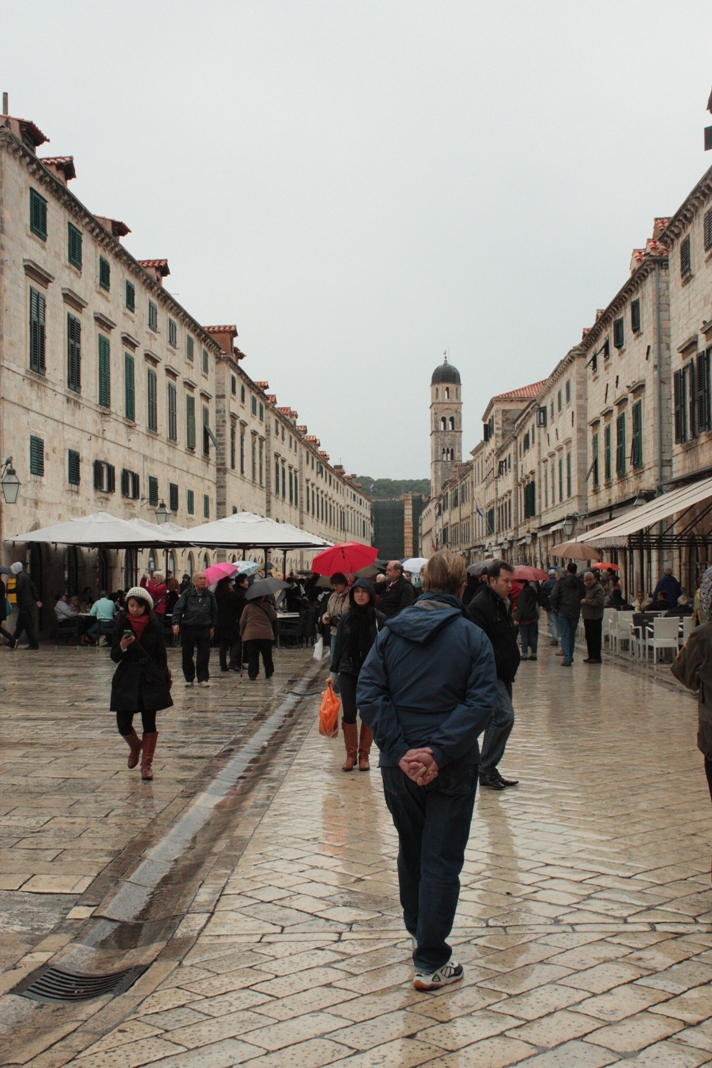
Old Town in Dubrovnik, Croatia
“Good for me, bad for them.” These were the words my friend and student Zehra, a 40-year-old mother of three, spoke to me as we sat together in her cramped apartment in Newport News, Virginia, 14 years ago and watched the words “Crisis in Kosovo” flash across the television screen.
It was a memory I thought was long forgotten until my European travels took me to the Dalmatian Coast of the former Yugoslavia where Zehra once lived a couple of days ago. Once the scene of ethnic cleansing on a scale not seen since the era of the Khmer Rouge, the multiple nation states carved out of the country Tito once held together by force has few signs of the conflicts that dominated news screens through much of the 1990s.
The otherworldly scene I watched that day flickering on the screen of Zehra’s television of Kosovars fleeing their homeland in overcrowded trains or cluttered into muddy fields without food or shelter was not unfamiliar to Zehra, a native of Bosnia-Herzegovina, who, through some act of fate I’ve yet to understand, became my English student – my most dedicated one, I might add.
As part of my graduate school training in teaching English as a second language, I was required to tutor someone. Having followed the conflict in the Balkans since I was a high school student and then again as a college student when my boyfriend served aboard a carrier in the Adriatic Sea, I chose to tutor a family of Bosnian refugees.
It was supposed to be a two-month endeavor. Somehow the experience moved beyond grad school project, and I became the Sulejmanovics’ private tutor and only American friend for nearly four years.
English is one of the world’s most complicated languages, and teaching concepts like silent “e’s” and diphthongs to a family whose native Serbo-Croatian language is entirely phonetic represented an unusual challenge. And often, the confusing, inaccurate Bosnian-English dictionary I relied on when nothing else seemed to work only compounded my difficulties.
But the Sulejmanovics were more patient with me than I was with them. They laughed at themselves and at me when I tried to repeat the Bosnian words they attempted with little success to teach me. They showered me every visit with huge meals and introduced me to cheese burek and Bosnian style baklava. Always Zehra cooked in the style of the old country, keeping a 25-pound bag of flour in her kitchen pantry.
Their generosity to me was boundless, even when they had so little
For Zehra, seeing the Kosovars on TV that evening made her relive a nightmare past that I could neither begin to comprehend nor successfully console.
“It’s just the same,” she said to me, watching the terror-stricken faces of mothers with crying children. “The same.”
Zehra curled her arms to her breast and then with quivering lips described to me how Serbian police forced her family to abandon their home in Srebrenica, how she walked over the mountains in the snow with her youngest son in her arms.
“Mirsad,” she said, referring to her now pre-school age boy, “was only nine months old,” She began to cry. “Nine months old!”
She remembered bombs falling day and night, and her middle son Nedzad told me about the Serbian tanks rolling into town.
After leaving Srebrenica, the family lived in Tuzla for a time in a house with 25 other refugees, sharing one room with four other family members.
Understandably, she called her two-bedroom apartment in Newport News “big.” Many of her neighbors down the dingy apartment hallway were refugees also. Some were Serbs, and she felt no malice for them. One was her dearest friend.
As is so often the case in war, those most injured by it have the least interest or investment in it.
When I last saw her, Zehra was working in a camera factory alongside her husband, Sevad, a former teacher with an astounding grasp of geography. When Sevad, who felt out of place in theses strange surroundings where everyone seems to have money and where women are often as powerful as men, talked once of going home to Bosnia, Zehra clutched Mirsad to her and said she would stay in the United States, no matter what.
And she looked at me with soft brown eyes and then planted a kiss on Mirsad’s head – the baby she thought would never survive to attend American kindergarten.
Her gratitude to the twist of fate or act of God that brought her here was boundless, as was her devotion to those who helped her.
When I attended a parent-teacher conference with Zehra one evening and sat beside her as the teacher gave us glowing reports of Mirsad’s progress, Zehra looked at me, squeezed my knee, and said quietly, “My teacher.”
Weeks later, as she practiced the conjugation of English verbs with me, she said again with that affectionate and unforgettable smile, “I love my teacher.”
When Zehra came to the United States, she had only an eighth-grade education, could not speak a word of English, and had no employment skills. After four years of tutoring from her imperfect private teacher, she was outstripping her more educated husband in her understanding and speaking of the English language and her confidence in the new American landscape.
Until this week, Bosnia-Herzegovina seemed very far away to me, having long been absent from American television screens. It had dissipated from the radar the way war, conflict, and misery always do. Whether or not the lessons (if there were indeed any) from the wars in the Balkans stick remains to be seen. Prejudice, like family heirlooms, can be passed from generation to generation.
But not for Zehra. If indeed she had any prejudices against neighbors of differing faiths and ethnicities in Bosnia, they fell away when she landed on American soil. With survival often comes wisdom.
That Zehra came to smile again and think of mundane things like what to buy at the grocery store and what color to dye her hair taught me something I will never forget – that while there may be some things on this earth worth dying for, there are far more for which to live.
Posted by Deborah Huso on Nov 13, 2011 in
Motherhood,
Mothers and Daughters,
Success Guide 
My grandmother: training the next generation
You’ve heard the old adage, “Listen to your mother.” Well, when your mother is a teacher accustomed to having other people listen to her and bend to her will, you learn pretty quickly that listening is in your best interest, at least when your car is still on her insurance policy….
The same goes for a grandmother who has been at one and the same time a factory worker, farmer, homemaker, and mother and who can churn out hundreds of lefse in one day (and yes, because it’s a Scandinavian food, you can only make one at a time), get 20 different bowls of food hot and steaming on the dinner table all at the same time, and chop an invasive black snake’s head off in one fell swoop with a kitchen knife without compunction.
I grew up under the example of these stern women, influenced by their relentless stoicism in the face of adversity, their insistence on getting what they want, and their dedication to seeing that the world bend as much as possible to what is right and good…or at least what they believed to be right and good.
Perhaps it was their stoical Scandinavian ancestry and the sense of personal responsibility that comes of being Lutheran that made them the unyielding, witty, and fearsome creatures that they are.
It was my grandmother who taught me how to sew, how to make things grow, and how to laugh at the absurdity of everyday life. She passed on to me old family recipes, showed me how to kill bugs with soap and water, how to stop the itch of a mosquito bite, and instilled in me the usefulness of knowing how to drive a tractor.
And then there was my mother, who, after four decades of reading, studying, and teaching the eternal truths of Chaucer, Shakespeare, and Dickens and watching the careful interactions of young people dancing in that netherworld between childhood and freedom, tried to pass onto me her, at one time, nearly flawless understanding of human nature. Better informed than a psychologist on what made people tick, she gave the soundest advice on how to handle human interactions. It was advice I rarely followed but always learned I should have.
From these two women came practical life lessons that I have often taken for granted as much as washing one’s hands before dinner. But their simple advice, both spoken and demonstrated, has often been my guidebook through the twisting path of life:
- Ignore negative criticism; accept constructive criticism and compliments graciously.
- Never send form Christmas letters. The only person who cares that your two-year-old has an IQ of 160, that your daughter just got accepted to Harvard, and that you and your husband spent three months last summer flying around the world in a hot air balloon is you.
- Do send personal, handwritten thank you notes, especially after weddings and funerals.
- Have the willpower to walk away when you don’t get your asking price from a salesperson. This is especially true when shopping for cars or buying homes. You’ll likely get a call in the morning….
- Buy 12 five-piece place settings, even if your dining room table only seats eight. Despite the china salesman’s demonstration, you can only stand on a teacup so many times before it breaks.
- Turn off the television. You’ll find you have a lot more time on your hands than you think.
- Keep a garden. You never know when it might come in handy to know how to produce and preserve your own food.
- Pick your battles carefully. Nobody listens to the person who always complains and criticizes.
- Learn how to do your own taxes and home repair or marry somebody who can do them for you.
- Never say anything you wouldn’t want repeated.
- Always say “please” and “thank you,” especially to your spouse, your children, your employees, and wait staff.
- Avoid airing your political and religious views in public.
- Remember that skepticism is your best defense against salesmen, politicians, lawyers, doctors, and the media.
- Maintain high standards. Others will emulate your example.
- Always remember and recognize the birthdays and special holidays of your friends and family, even if you think it’s just an excuse for Hallmark to make more money.
- Wear high heels to church, even when you’re 80. How you dress reflects how you feel about what you’re doing.
- Never stop doing anything you love, even when you’re 90. You are as young as you act, no matter how it feels.
- Don’t go to sleep when passing through the Grand Tetons. That might be the day a grizzly bear crosses the road.
- Friends are people who call you when you’re troubled, not just when they are.
- Remember that happiness comes from living up to your own expectations, not other people’s.
Posted by Deborah Huso on Nov 6, 2011 in
Musings,
Success Guide My husband said to me recently, after a disagreement about how I operate my professional and personal life, “You know I really admire the way you fling yourself blindly into life. It’s one of the reasons I fell in love with you. But it’s just not smart.”
You’ve probably heard statements like this dozens of times: “I love you, but….” We all hear them. They are the bane of happy relationships. If you love somebody, but this or that, maybe you shouldn’t be with him or her…unless, of course, you have to be. You have to look after your kids, your parents, that dog you adopted from the SPCA.
This post isn’t about loving some but not all of a person, however. It’s about living, not blindly, but, as I prefer to argue, openly.
And I’m not talking about hopping out of the proverbial closet if you’re gay or letting your grown children know you’ve divorced…six months after it has happened. I’m talking about being open to life, to the opportunities it offers at every turn, the opportunities we often miss because we’re afraid, afraid of trying something new, striking up a conversation with a stranger, saying “yes” when our self-protective instinct wants to say “no.”
Everything extraordinary that has ever happened in my life has happened because I took a massive leap of faith, defied the naysayers, hoped, believed, and closed my eyes and jumped. When I told an acquaintance of mine once that much as I enjoyed sea kayaking, I didn’t know if I was up for whitewater, he said, “Whitewater kayaking is all about fear management.”
So is life. Conquer your fear, and the thing you thought you couldn’t do becomes possible, manageable, maybe even smart.
For those of you who have been reading my columns in newspapers and magazines for the past decade, you have heard all of this, to some degree or another, many times before. But I think it bears repeating. It is probably why my dad, from the time I was a teenager until deep into my adult life, would tell me every time I left home to go on a date, return to college, go back to my apartment in the city, “Drive fast, and take chances.” He wasn’t talking about how to drive my car (though I’ve been lead-footed, I’ll admit, since age 16); he was talking about how to live my life.
Overcome fear. No matter what. Overcome it.
As many a philosopher has pointed out over the centuries, it is beyond fear that we find the true meaning of our lives.
When I was a child, I was incredibly afraid. Everything from piano recitals to going away for a weeklong church summer camp terrified me. They pushed me outside my comfort zone. It was one thing to play the piano in my parents’ living room, quite another to play it in front of an auditorium full of people. And it was one thing to have a sleepover at a best friend’s house, but to bunk in a cabin in the woods with girls I hardly knew? Now that was scary.
But as I grew older, I slowly began testing my own limits, learned to say “yes” to crazy, nerve-wracking things like singing the “Star Spangled Banner” at the opening of every high school basketball game and leading discussions on comparative religion in the college Humanities classes I started teaching at age 23, finding myself, on many occasions, younger than my students.
These small dares led to ever bigger ones because I had begun to discover that saying “yes” to things that terrified me taught me, little by little, to push through fear. And the amazing thing about fear is that once you push through it, it disappears. You’re not only never afraid of that particular thing again, you find yourself a little less afraid of the next scary thing because you’ve proved, after all, you can handle fear.
By the time I was in my mid-twenties, my fear management had grown to a whole new level. I was willing to drop a full-time, good-paying job at an ad agency, give up my penthouse apartment, and take a wild risk becoming a freelance writer in the isolated mountain reaches of western Virginia. Everyone, except my dad, told me I had lost my mind, and even my dad admitted, years later, that he thought I had lost my mind, too, but was smart enough to keep his mouth shut.
A lot of people will chastise themselves, when they are young anyway, for taking a risk and falling flat on their faces. After all, it’s pretty darn embarrassing when a girl turns down your request for a dance, so why on earth would you ever risk yourself by asking a woman to marry you? You see how this reasoning against risk-taking can get out of hand. Pretty soon, you’ll be avoiding everything that makes life worth living.
Consider instead, if you’re feeling a little fearful, of twisting your thinking. Learn to regret the risk not taken, and pretty soon it will become habit to put yourself out there. So strong a habit, in fact, that you’ll kick yourself until you’re black and blue every time you fail to take an opportunity and see where it leads.
I’m still beating up on myself for failing to get the business card of a Belgian businessman I met on an airplane a couple of weeks ago who sought me out because he wanted to talk to an American who could speak French. I was afraid he might think I was hitting on him. When I told my husband about this failure on my part later, he said, ironically enough, after I had described the gentleman, “I bet he’s in the diamond trade. You could have had a new client. You’re an idiot.”
Hmmm. I thought so, too.
I should have just flung myself blindly into the possible opportunity. But then, I don’t really see staying open to possibilities as a blind leap of faith. Rather, it is a calculated sense of foresight. Life is too short for giving into fear. Sure, you might embarrass yourself, offend someone, maybe even lose your shirt (metaphorically speaking). But that’s the beauty of risk…and of life. You really, truly never know what’s around that next corner. And if you operate from a place of opportunity instead of a place of fear, chances are whatever is around the bend is pretty darn grand.
Posted by Deborah Huso on Oct 26, 2011 in
Men,
Relationships Have you ever noticed how when you bare your heart and soul to a man he retreats? Into his cave. And doesn’t come out. For a very, very long time. Or if he’s going through a personal funk, he draws inward, locks you out, refuses to answer the door. If he’s your husband, he gives you that look when you walk into the room—that look that says, “talk to me or come near me, and I will totally blow up at you.” And if he’s your boyfriend, he stops calling, stops e-mailing, doesn’t return your efforts to reach out.
And you sit there…stumped. And wondering. What did I say? What’s wrong? And why won’t he let me help? Why won’t he let me in?
After you’ve lain awake for a couple of nights, staring at the ceiling, trying to figure him out, he reappears…as if nothing has happened, says, “Hey, you want to go out to that new bistro tonight and hear that band play?”
Did I imagine it all? You ask yourself. Maybe he’s right, and I read into things, and nothing was wrong at all.
Chances are, 90 percent of the time or more, you did not imagine it, he is not right, you were not reading into things, and something was definitely wrong. But men aren’t like us. Where we question ourselves and every girlfriend who will listen when something goes wrong in our lives, they deny and avoid, pull back into the safety of the man cave where women can’t get to them and make them talk or feel…well, most of the time.
But every once in awhile, whether it’s due to lack of sleep or desperation, they seek us out, practically beg for our understanding, our empathy, our love in spite of every foolish, wayward, abnormal thing they’ve ever done. And we have to be there. Fail to be there, and you’ve set yourself back six months at least. Because men don’t forget these things. Their pride is easily wounded. Reject them when they’re down, and they’re not likely to come crawling back again anytime soon.
So what happens when you’re having one of those days when the empathy isn’t coming or when he’s the one putting you into the funk? Where’s our cave, I ask?
Well, ladies, the hard truth is…we don’t have one. Just try to exercise your right to a cave, and watch what happens. He will follow you into every room, claiming you don’t listen to him or respect him. He will tell you for months afterward that “you’re never there for me.” Or he may call you four or five times a day or send you kind of heartbreakingly desperate e-mails, rife with the words of love he thinks you want to hear (and you do want to hear them—that’s the kicker). And if you don’t respond to these entreaties, ladies, what will he do? That’s right…into his own cave he goes.
He just will not let you have your cave. In fact, the whole idea that you even want one, much less have one, absolutely terrifies him.
So what’s up with the double standard?
It’s really not their fault there is one, so let’s start there. Men are not typically raised to be empathetic, open, or giving. To behave with that kind of attitude puts them at great emotional risk. You may be asking yourself now, Well, I put myself at emotional risk all the time! Yes, you do. But you have that wonderful asset called girlfriends. No matter what happens in your life, one of those women in your network of mutual rescuers will be there for you, prop you up, and push you on your way again.
You don’t honestly think men go to their male friends and say, “Man, I don’t think my girlfriend loves me the way she used to, and I’m really bummed about it,” or “My wife has been really down for a couple of months. Do you think I did something wrong? What should I do?” Now, I do hate making generalizations, and there may be a man or two out there who asks these kinds of questions of his buddies, but if there is, I’d like to meet him.
The sad reality is, ladies, all these guys have is you. It’s not just sex and companionship they want (though I know it seems like that at times). Whether they will openly admit it or not, men need women for the emotional sustenance they provide. We are the one place they generally feel pretty safe going to when life is a mess, that is, if you haven’t attempted to build a cave for yourself in the backyard.
If you have, however, my advice is to fill in the hole and put away the shovel…or at least build the cave at a single girlfriend’s house. Because while the guys may indeed behave like Neanderthals at times, they really do need and want you on a level they don’t understand (and probably don’t want to understand) themselves. Assume your role as caregiver to the cave dweller with love and care, and when you need your own cave, just make sure your husband isn’t around when you retreat into it…and remember to be back by dinnertime.
Posted by Deborah Huso on Oct 24, 2011 in
Mothers and Daughters,
Success Guide,
Writer Rants 
The author at work in the "summer office"
More than a decade ago, when I was just beginning to launch my career as a full-time freelance writer, I remember driving through Goshen Pass in western Virginia, pulling off the road periodically to frame scarlet sugar maples and golden poplars in my camera lens for a fall getaway article I was writing. Still giddy at the idea I was actually pursuing this crazy dream of mine to live by the written word, I turned to my travel companion, a friend who had accompanied me on so many of these writing journeys, and said, “You know what? I’m a writer. I’m actually a writer.”
He regarded me with understandable puzzlement and said, “Well, of course, you’re a writer.”
“No, really,” I insisted, as if daylight had suddenly shattered through the sodden tree limbs overhanging Route 42, “I’m a writer. I’m actually making a living by writing.”
Of course, this was not news to my friend. But somehow it was news to me. Through late nights at the computer and endless prospecting for freelance work, I had somehow been so caught up in the business of making a living by my craft that I had failed to notice the point at which I actually became a professional writer.
But then the question remains, what exactly is a writer? And have I, for the past 30 years, been selling myself short because I was not, for nearly 20 of those years, earning a living wage as a writer? How many writers, after all, can earn a consistent living wage by their craft? After all, it took me two decades to figure it out.
You see, I was not suddenly a writer while photographing autumn foliage in Goshen Pass. Nor was I suddenly a writer when I published my first newspaper article or my first short story. If we want to talk about writing and what it means to be a writer, well then, I have to go back much farther, to a period that doesn’t appear on my resume. Because I have been a writer almost since I could hold a pen, quite literally.
I wrote my first short story when I was six years old. I was no child prodigy. I had been reading biographies of famous Americans written for young children and had loved them so much I wanted to write my own. So I wrote a story (though I probably considered the effort great enough at the time to be called a book) about a pioneer girl named Ellen Kay Brown. And I illustrated it, too, with pencil sketches of girls in bonnets and fathers with grisly beards.
I handed the notebook-paper story to my mother, a high school English teacher, for my first critical review. She didn’t paste it to the refrigerator with a magnet or smile and exclaim how proud she was of my effort. She took it in her hands quite seriously, as she would a research paper on Hamlet or Macbeth, and, red pen in hand, proceeded to critique my first attempt at literature, circling my childish “enuff” and changing it to “enough,” capitalizing proper nouns, inserting punctuation.
Was this some cruelty on her part? I never for once thought so, but perhaps some more indulging parent might. This was par for the course in a household where books lined shelves in rooms upstairs and down and where anyone of blood relation would know the difference between “can” and “may” as well as “lie” and “lay.”
I took my little manuscript back, absorbing her red corrections, recording their sense for the next effort, and thus began a ritual between us that lasted until I left home for college. I wrote; she critiqued quietly with her red pen. By the time I graduated from high school, I was one of only a select few in the world who knew, as if by second nature, when and when not to use commas as well as how to give stylistic flair to an exam essay (though my mother claims no responsibility for the latter skill).
Today my mother keeps all these carefully reviewed manuscripts—penciled short stories, illustrated poems, carefully typed essays—in a cabinet in the library. They are small treasures to her, the woman who said, when I declared at six years of age that I was going to be a writer, “It’s never wise to count your chickens before they hatch.”
But I’ve always been counting chickens, hatched and unhatched, and I’ve never assumed anything other than success. That has been my way. It would have to be my way. Only a dreamer could ever believe it possible to make a career out of language.
But still the question—when did I become a writer? My first sense that I might be one actually came when I was a senior in college and my mentor and three-time history professor said upon reading my senior thesis, “There’s nothing I can tell you about writing. I wouldn’t know how to critique you.” My mother never said this, but on the infrequent occasions when I showed her a college or graduate research paper, she would read it, first page to last, hand it back, and say only, “Looks fine to me.” Flipping through the paper, I scanned the pages for the familiar red ink—nothing. Full circle at last, I thought.
Yet no writer who is a good writer ever thinks his or her work is good enough. I read articles I wrote only months ago and think today they look horrible. I have become my mother minus the red pen. All things can be improved upon.
Yet all writers know this, and all writers know, deep down, that it is not so much the paycheck that justifies them as authors. It is the constant development, the constant effort. I have been a writer since I was six. An editor might be intrigued to know that I have more than three decades of experience. But would that intrigue persist if she knew the whole truth?
Probably not.
And that is the sad reality of the writing life. Until you have a paycheck from a publisher, and preferably several, you are not a writer. Your skill level, your decades of practice, your passion are irrelevant . . . at least to most editors.
Did you ever notice that the editor who constantly sent you rejections of your pitches suddenly changed his tune when one of his colleagues took a chance and published your work . . . with success? Yes, once you have a few publishing credits behind you, the rejections trickle to a minimum. Which makes you wonder—does good writing count for anything? Or are editors, like movie producers, tied to the tried and true?
Well, yes and no. Good writing does count for something. After all, it’s easier to publish good writing than bad. But getting good writing noticed, in the end, is a matter of luck. For myself, I ran into an overwhelmed newspaper editor willing to take a chance on me and the editor of a start-up lifestyle magazine with a dearth of authors. After that, everything began to fall into place. Just ask Nicholas Sparks how he became a best-selling author overnight. His answer, like that of so many other wildly successful writers, will make you dream like the daily players of the lottery and gnash your teeth at the same time.
It is luck.
But it’s also persistence. Beat the statistics by flooding the market.
I guess my mother, my original editor, knew a thing or two. I kept passing her the notebook paper, and one day it came back without red ink. Was it talent, or did I beat the odds? Perhaps a little of both . . . but maybe it’s time I started playing the lottery.