Posted by Deborah Huso on Mar 18, 2013 in
Travel Archives 
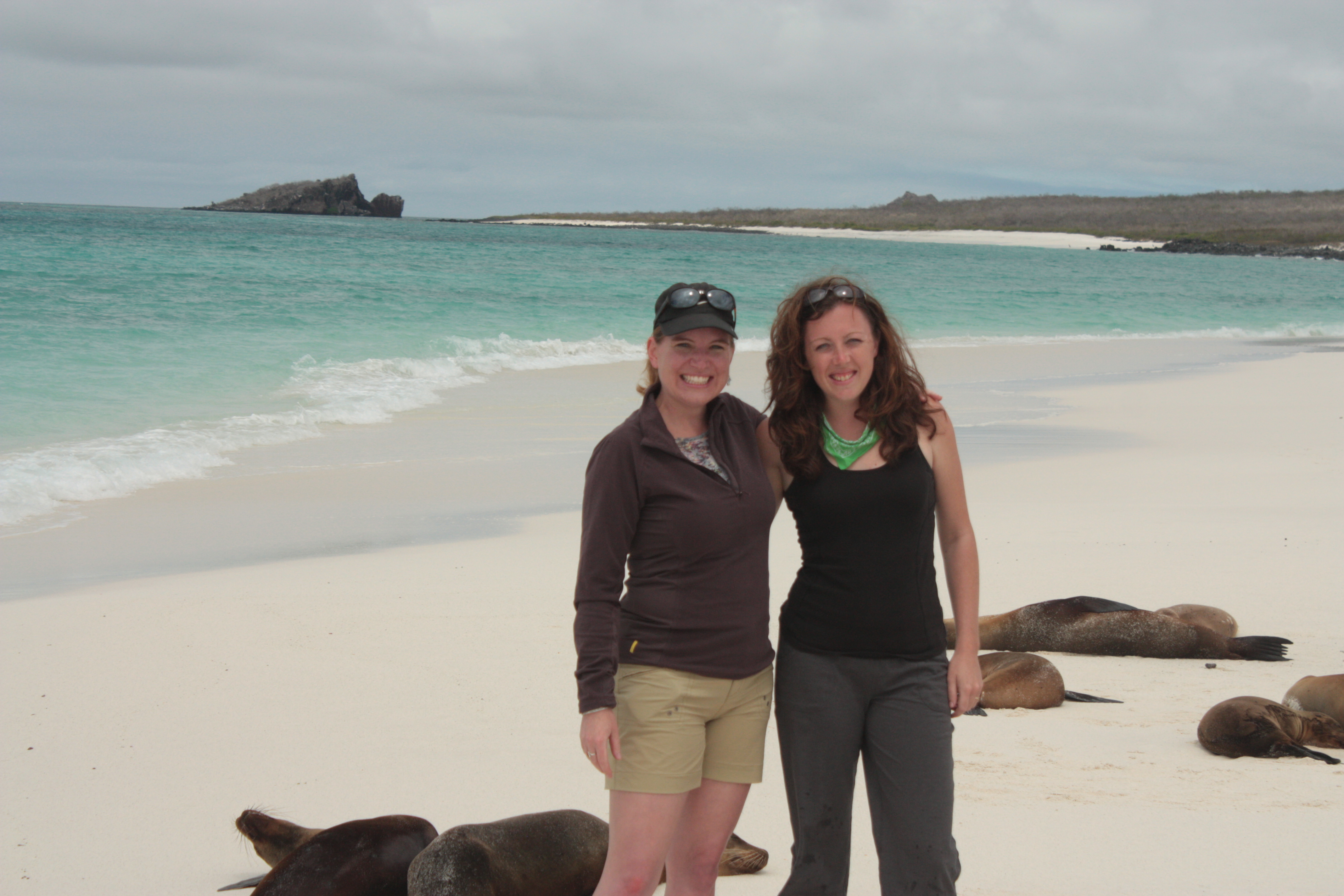
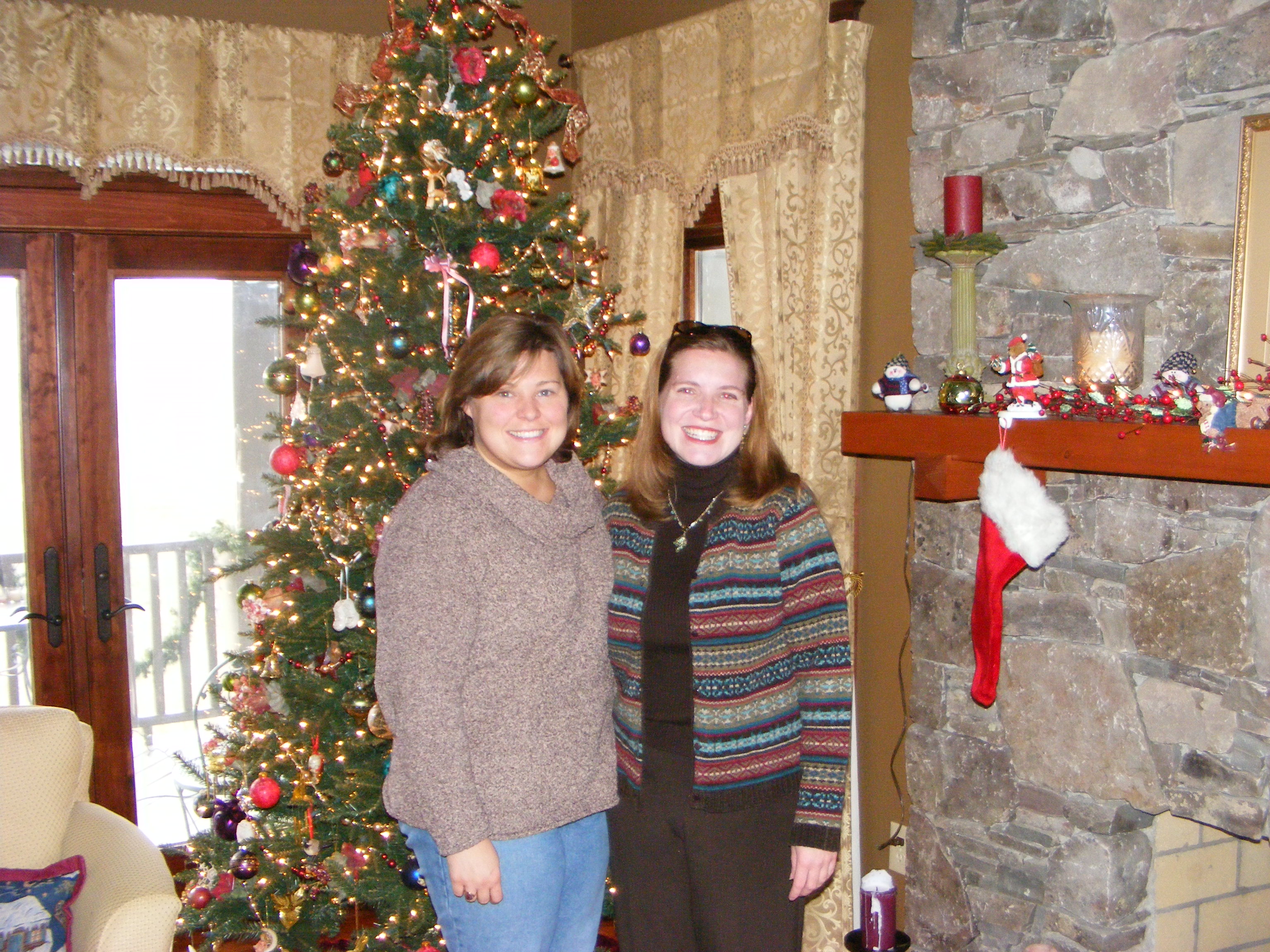
With one of my girlfriends after swimming with sea lions in the Galapagos Islands
A couple of weeks ago, the Professional Association of Diving Instructors (PADI) contacted me out of the blue and asked if I’d like to get certified as a SCUBA diver. Apparently, a couple of their media folks had had their eye on some of my outdoor recreation and adventure travel writing and thought I wouldn’t necessarily be the worst person in the world to teach diving to.
They could be wrong about this.
I’m claustrophobic to the degree that I will occasionally have mild panic attacks on small commuter jets. And I’m terrified of deep water, especially if I can’t see the bottom. Tell me while I’m in this deep water where I can’t see the bottom that a hammerhead shark might come drifting by, and I might just suddenly decide I want back in the skiff.
So why I told the folks at PADI, “Absolutely, I’d love to learn to dive,” I have no concrete idea. I just know that some of the best experiences of my life have started out scary as hell. Thus, I have a default setting in my brain that says if something seems inordinately challenging or frightening, I just need to jump in and do it.
Fortunately, I have friends who are exactly the same way.
One of them is coming with me on this SCUBA diving trip to the Bahamas. When I asked her if she wanted to go, she squealed and said, “YES!!!!”
Strangely enough, she, like me, is mildly claustrophobic and has never had a particular urge to learn to dive. After her confined water dive experience this last weekend, she told me she was exhausted, felt utterly stupid, somehow passed the test, but was as excited as ever. “But you know since you and I are going to be diving buddies, if you decide you really don’t want to go way down there deep to look at that shipwreck, you know I’ll be okay with that, right?”
I nodded and advised her, given our claustrophobia handicaps and poor multitasking skills (how do you remember to descend slowly, equalize your air spaces, and operate your buoyancy control device all while carrying a steel tank on your back?), that we might come across as geriatric divers. We decided to come up with an underwater hand signal for “how about we ditch this dive and go get a cocktail?”
Which comes back to the question of “Why do it? Why do something scary and unfamiliar that you’re not even sure you’ll enjoy doing?”
Because it might change your life. That’s why.
There are anthropologists who would argue it’s just in the genes of some of us to be risk takers. Is your ring finger longer than your index finger? Mine is. That’s supposed to mean I’m genetically predisposed to sky dive and cheat, ever on the lookout for the next big thrill. Personally, I think it just means I have funny looking fingers.
I don’t do the things I do because I have a genetic compulsion to live on the edge. I do them because experience has taught me that wonderful things happen when you dare to step outside the familiar trappings of your life, challenge yourself, and introduce yourself to people who fire your brain.
When I moved to the isolated mountains of Highland County, Virginia, all by myself 11 years ago, apparently on a whim, quit my day job, and began to pursue a full-time career as a writer, pretty much everyone in my life thought I was crazy. I didn’t think I was crazy. I was just doing what I do–testing the waters of a grand new experiment in living, which in this case was seeing if I really could do what I wanted to do, live where I wanted to live, and be who I wanted to be without going bankrupt.
It turns out I could.
And there have been a lot of other things I’ve done since then that looked risky as hell at the outset but turned my world upside-down in beautiful and amazing ways.
I had my first kayaking experience off St. Croix when I was pregnant with my daughter and a bit reluctant to go paddling off into the sea on a whim. But I shrugged and did it anyway. Years later, sea kayaking is one of my favorite things, and it has allowed me to paddle up to calving glaciers in Alaska and drift along colorful rock formations on Lake Superior I could never have seen otherwise.
Far be it from me to take on the world from the deck of a mega-cruise ship. Because life isn’t something you watch. It’s something you do.
Theodore Roosevelt once said, “It is impossible to win the great prizes of life without running risks.” How true. There is nothing nor anyone in this world that I value highly that I have not risked wildly or worked hard to have. My deepest, most rewarding friendships are the result of long and dedicated acquaintance where I dared to risk vulnerability and censure by being myself. The incredible career I live and breathe every day is the result of a no doubt inane belief I could not only pay the bills as a writer but live a pretty darn good life, too. It took years of work and a willingness to leap off the high dive into a precarious world where paychecks didn’t come biweekly to pull it off.
This is not to say risk always pays off in an immediately positive way. Sometimes it blows up in your face. That’s why it’s called “risk.”
Not every wild venture I’ve taken on has turned out for the best. Heaven knows I’ve fallen in love (or thought that I had), only to discover the person on whom I’d showered so much admiration and affection had borderline personality disorder. I’ve taken on a new and way out of my field job with hopes of grand financial remuneration and promotions only to be told by a boss and self-proclaimed amateur chef who paid $300 for a gourmet mushroom that I had to wait my turn, no matter how smart I was, to climb the corporate ladder.
But even the risks that seem not to pay off at first have their own less obvious rewards. They offer lessons that make the next risk not quite so risky. Once you know how to kayak, how to shoot a bow and arrow, how to hit a bull’s eye with a pistol, how to keep from screaming when a sea lion dives at your snorkel mask, and how to survive a broken heart and a foiled career move, things like learning how to SCUBA dive or venturing into a foreign country alone don’t seem quite so daunting. You’ve already proved you can stare down fear.
Don’t confuse staring down fear with not being afraid, however. I’ve never said I wasn’t afraid. Take for instance my trip to Ecuador last summer. After developing a fond acquaintance with a local from Guayaquil who was trying to teach me functional Spanish, I took him up on his offer to show me the city. After we’d strolled the crowded Malecon, eaten ice cream cones on the river, and he’d tested my Spanish reading skills by asking me to read aloud the inscriptions on local monuments, we walked away from the tourist areas, deeper into the heart of the city. I heard gun shots, the streets were more isolated, some apparent acquaintances shouted something in Spanish to my companion that seemed to suggest he had quite the prize in this long-legged, blond American girl he’d found. My gut instinct told me to flee, to find my way back to the five-star hotel where I was registered, to abandon this latest scheme to experience some of the “real” Guayaquil.
But something of the risk taker held fast in me. I smiled at my escort, took his hand, and we walked to dinner where I understood nothing of the exchange he had with the waiter. Instead of worrying about it, I resolved to revel in the sunset over the river, to absorb the melodic sounds of my companion’s voice as he spoke to me in beautifully accented English with a few Spanish words thrown in, and remember this was living. The next morning, my Latin companion delivered me to the airport safely and put me on my way back home.
When I read, a couple months later, about the dangers of Ecuador, about how supposed taxi drivers would pick up foreign tourists and then deliver them into the hands of criminals who would rob them and sometimes even commit physical violence against them, I marveled at my bravery (ignorance?) in Guayaquil. However, I would not have traded the experience of touring the city with a handsome and intelligent local at my side for anything. Despite my girlfriends’ teasing that I had acquired the “bucket list” experience of finding myself a Latin lover, what really counted for me was the insider’s view of Ecuador I received—my companion’s perspective on local politics, social injustice, poverty, and crime. He had brought me, for a moment, into the thick of Ecuadorian life.
And that’s what risk taking does—it takes you into the thick of things. It’s where life happens. So next time a wild opportunity throws itself on your doorstep and you’re not saying “yes” because you’re scared, it might be time to reevaluate. Saying “no” to a possibly life-changing experience isn’t really about being cautious or safe so much as it is about being cynical. And as American political satirist Stephen Colbert says, “Cynicism is a self-imposed blindness, a rejection of the world because we are afraid it will hurt us or disappoint us. Cynics say no. But saying ‘yes” begins things.”
So, readers, let’s begin….
Posted by Deborah Huso on Feb 26, 2013 in
Stories From the Road,
Travel Archives 
Pegram Parlor at the Linden Row Inn on Franklin Street in Richmond
My latest “Stories From the Road” column has hit the press. This one, on the Petersburg and Richmond haunts of Edgar Allan Poe, will appeal to anyone who has a hankering for how to get closer to the master of the macabre. Though it’s not the easiest thing getting inside the head of the literary man who married a 13-year-old girl. Even in 1835, that was a bit unusual.

The dining room at Bistro 27 on Broad Street
Nevertheless, while you’re checking out Poe haunts in Virginia, be sure to give yourself the best eats and digs while you’re exploring. Spend the night at the Linden Row Inn, and be sure to ask for “Pegram’s Parlor.” This is the inn’s classic honeymoon suite. Else you might find your lodgings a little rough around the edges. Then hit Bistro 27 for dinner. I recommend the chef’s special beef ravioli. And while you’re wining and dining, you can watch the world go by on Broad Street.

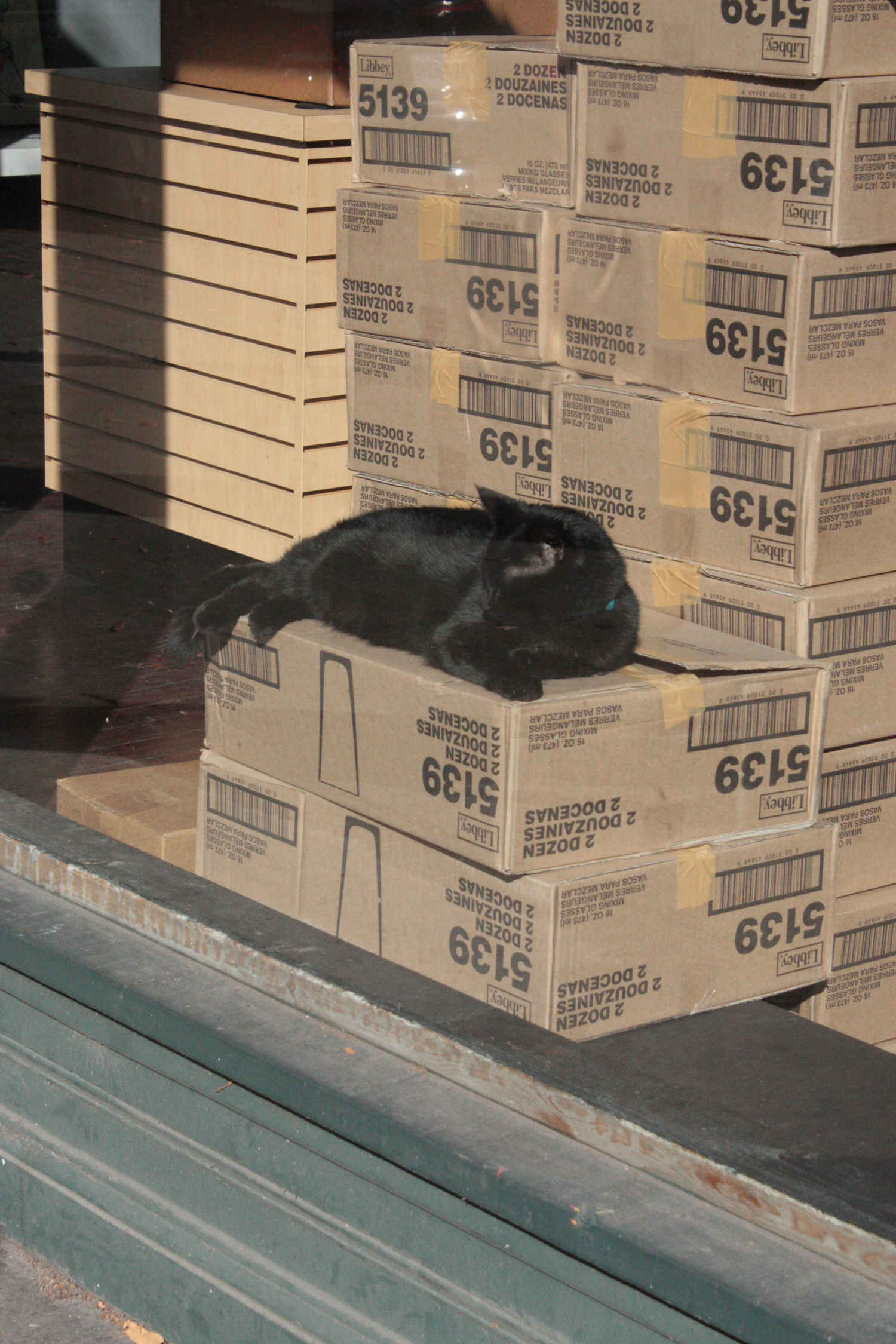
Kitty in the window on Broad Street
Posted by Deborah Huso on Feb 21, 2013 in
Men,
Relationships It occurs to me I should not be blogging now. It is 1 a.m. I am sick with bronchitis. I am exhausted. My daughter is sleeping in my bed. I have spent the past two hours mothering…but not to a child—to a man. A man who took nearly an hour to tell me what was wrong. It took him that long to run through all the various diversions he felt compelled to run through before finally being honest about the fact that he was suffering and needed me.
You women who read this will know what I am talking about—the way the men in our lives can emotionally exhaust us more than our children do.
Children are simple and direct: “Mommy, I am tired and hungry. Mommy, I miss Grandpa, and I am sad.” Their wants and fears come out easily, then the tears, then the hugs and kisses and the soothing, and it is over.
Not so with men.
Over the course of their wayward socialization and upbringing, men’s emotional directness has been bred right out of them…unless it’s something they can solve with a fist fight. If they have to cope with an emotion that is not anger (or that can’t be translated into anger), they are lost.
We women pay the price.
That’s because we are not just their wives and lovers. We are their best friends and the stand-ins for the mothers whose skirts they once cried into as little boys. They do not have our network of emotional sustenance. We fill our emotional buckets with the kind and encouraging words of other women. It is a resource men lack. If they do not have an understanding wife or girlfriend, their emotional buckets stand empty.
I have said this often enough on this blog—that women are the one and only emotional stand-in for men in most cases. Even your husband’s best friend isn’t going to be capable of much more than a pat on the back, followed by, “Hey, how about we go for a ride?”
A male friend said to me recently, “For men, emotional sustenance is supposed to be provided by a beer and a football game.”
But when beer and sports don’t cut it, the lucky few with loving women in their lives will come limping and sheepish to our arms, beating around the bush for a couple of hours, but coming nonetheless—to women who, more often than not, have just finished a 10-hour day at the office, made a barely competent dinner for the family, bathed, soothed, and put to bed a couple of kids, and are now sitting blithely for the first time all day on the floor in a corner of the bedroom gleefully painting toenails red. Thrilled for the first moment of peace and absence of need in their lives.
But then the man intrudes like a roving brown bear.
The best among us will set aside the red toenail polish, summon our last ounce of understanding and tolerance, and listen. But sometimes we just cannot help it. We turn the look of death on the beaten down husband, fling the bottle of red nail polish at the quickly closing door, and peevishly deny him sex for a week.
It’s not that we are cruel, guys. (And yes, I know you are reading this, slightly aghast.) It’s that we are exhausted. Women’s lives, whether because of biology or socialization, are loaded with caregiving—we tend to the emotional needs of our children, our friends, our lovers, our colleagues, even our pets, and we do it like it is second nature (because it is), but because we do it all day for days on end, we eventually run down, especially when the caregiving is sparingly returned.
One of my girlfriends told me recently she is actually grateful her husband has a few female friends. “It takes some of the heat off me,” she explains. “I get so bitchy when he’s needy.”
It’s not that we are angry at our husband’s or boyfriend’s failure to be an invincible knight in shining armor. Most of us are realists, and we do not expect men to fight off their dragons all on their own. We don’t think men in emotional need are weak. In fact, when we first fall in love, we find this sensitivity about them wonderfully endearing.
But sometimes, we do resent his deep emotional dependence on us, a dependence we do not share because we usually have female friends and relatives who tend to our emotional bucket filling long before the man in our life ever shows up with a water hose. By day’s end, we have often already been hosed down, dried off, and are ready for that glass of wine and a book in front of the fire.
But instead, in walks this man who has no deep emotional connection to anyone but us, and we can see from the wild look in his eyes that he is needy. And, as one of my girlfriends put it recently, because men have so much pent up emotional baggage, their need often turns into what she terms “emotional diarrhea.” She adds, “It’s like a contagion, and it can take over your life.”
Pretty soon your peaceful evening has turned into his dumping ground, as he recounts his screwed up day, awaits your verification that he is wonderful and his boss is just an idiot, and depends on you to restore his sense of manhood by sharing a rousing romp in the hay just to seal the deal that all is well.
Pretty soon it’s 2 a.m.
He is snoring peacefully, and you’re lying awake staring at the ceiling fan, wondering if any of your girlfriends are awake doing the same thing.
For the men who are reading this and wondering if they have deeply erred in sharing that most vulnerable part of themselves with their wives and lovers, let me provide some assurance: if the women in your life have to come your aid (no matter if they are staring at the ceiling wide awake at 2 a.m. afterwards), they adore you. Even if you’ve gotten a door slammed behind you with a bottle of red nail polish thrown against it a few times, still…rest assured…they love you.
If you can give a little back in return, then give it. Even if it as clumsy as a bouquet of flowers, still, give it. The acknowledgement will not go unnoticed. The women in your life do not need you so much as you think (sorry to disappoint, gentlemen). As a dear friend of mine puts it, women have other resources at the ready for their emotional sustenance: “Women are like the inflatable insulation that is blown into the wall and attic spaces of old houses — they simply know where the gaps exist and fill them, intrinsically. The men are not capable… It’s when we expect them to be that things go south.”
It is so true. Occasionally, however, give the unexpected. Fill a gap here and there, and watch that woman who has thrown a few too many bottles of nail polish and…ahem…other things at you morph into something a good deal softer and a good deal more ready to be there for you when life runs, as it will, counter to your expectations.
Posted by Deborah Huso on Jan 26, 2013 in
Girlfriends,
Men,
Relationships 
The three ladies who mentally dissected a cheese plate
I have to confess I’ve not received too many extravagant gifts from men. While I know there are women out there who would appear to belong to “the ring a month club” courtesy of their boyfriends and husbands, that has never been me. The best I’ve gotten from a guy short of an engagement ring is a pair of cross-country skis. (And let me tell you, that was thrilling enough.)
So I have to admit from the outset I don’t exactly come at the whole “guy showers girl with extravagant gifts” thing with a very clear perspective on the issue. Which is no doubt why my current boyfriend has thrown me a bit off kilter…and many of my girlfriends, too, who (like me) have never really experienced much in the wine, roses, and diamonds department.
Not that I’m complaining, mind you. I’d much rather have a kayak or a hiking trip to Peru than a diamond any day, but I’ve not gotten anything along those lines either. However, I digress….
My new beau is a whole different animal from what I’m used to. Not only does he have something on the verge of a conniption fit if I try to lift a 40-pound bag of dog chow out of the trunk of my car, but he insists on stopping along the side of the road to adjust the headlights on my car when I complain about them not performing well enough in the fog. (And yes, he has the tools for things of this nature magically handy at all times.) He also pulls out my chair at dinner (even when it’s at my own house) and refuses to allow me to stand up to refill my own wine glass. He is a model of chivalry, and I still can’t quite get used to it. The attention verges on decadence to my way of thinking.
But one of my well-heeled girlfriends begs to disagree. She does not find it in the least disturbing that he also buys me shoes, scarves, jewelry, new tires for my car, and anything else he can think of to bring a twinge of a smile to my face. In fact, she said to me only yesterday, “This is how a man is supposed to treat a woman, Debbie. He is wooing you.”
If that’s true, what have all the other men in my life been doing the past 20 years?
I’m not the only one asking this question, by the way.
A girls’ getaway to California this last week proved my point…and also proved what I think most educated men already know—that a woman (and a group of women even more so) can take the tiniest shred of an idea and run with it way past left field.
After a day out shopping in Sausalito and strolling through the John Muir Woods, my girlfriends and I returned to our hotel room to find an “edible arrangement” waiting in a refrigerator that the hotel staff had carted up to our room for the very purpose of keeping my chocolate-covered apple slices and pineapples appetizingly chilled. We all knew who the charming culprit was—my boyfriend (whom I will leave unnamed until I am certain I have charmed him to the degree he won’t dump me for talking about him on my blog).
Of course, before any female analysis of the chocolate-covered fruit in the pot could begin, we all set about devouring it as quickly as possible. (I got first dibs on the chocolate-covered strawberries—it was my boyfriend after all.)
Once the four of us were satiated, our bodies strewn across two queen-sized beds, torsos propped on pillows as if we were having a high school slumber party all over again, Sarah piped up, “I don’t think anyone has ever sent me a gift like that when I’ve been away traveling.” I see her cocking her head to the side and getting that slight twitch at the corner of her lip that she gets when she’s about to claim something is suspect. “Have you, Shiloh?”
Shiloh, whose heart has been recently decimated, shakes her head. “No, never.”
Megan, who is in her third trimester, continues munching her chocolate-covered apple slice and offers no opinion.
“I’ve never experienced anything like this either,” I say, though I can sense I have gained temporary “admired woman” status among my friends.
We make a rather hasty group decision (because it’s almost dinner time) to chalk this up to a delightful form of male chivalry and admiration to which all of us are unaccustomed but which seems…well…kind of nice. Who doesn’t like to end their day with chocolate-covered berries and pineapples carved into flowers?
So…out we go to dinner at an Italian café, followed by cocktails and bread pudding at the hotel bar. We return to our hotel room. We are casually sprawled about the room again in our yoga pants and PJs, and there is a knock at the door.
It’s 10 p.m.
We exchange looks. No one moves.
Then Shiloh, the bravest among us, hops up, opens the door, and a white-coated waiter is standing there with a platter loaded with more chocolate-covered berries, grapes, bread, and half a dozen types of cheese. He presents a card. Shiloh opens it, reads it, looks at me.
“Holy shit,” I say, nevermind the presence of the room service waiter.
Of course, as with the first delivery, we really waste no time digging into the edible delights, though we conduct our female analysis of the situation in tandem with the devouring of Stilton on rye.
“Um,” Sarah finally volunteers, her lip curling just a little again, “does this strike you as a bit over the top?
Shiloh and I look up in mid-chew.
“It is a little over the top,” Shiloh says.
“Twice in one day,” Sarah adds.
I nod and put down my goat cheese, feeling a bit disconcerted. Something about the decadence of it all is starting to unnerve me.
I can see Sarah’s brain at work. She is thinking, Is this guy a stalker? Is he marking his turf? Is he just loaded and has nothing better to do with his money?
I decide to take a shower, knowing that as soon as the bathroom door closes behind me, the girls will start analyzing, saying all the things they don’t dare say in front of me…not yet anyway. (That is how women are. Whoever leaves the room will undoubtedly become the subject of the conversation.)
Ten minutes later when I re-enter the bedroom, all is rather quiet, as if some conclusion has been reached without my consent. “He’s not an idiot,” Sarah says. “He is trying to impress your friends, too. He knows the weight of female opinion.” And Shiloh and I have to admit there is some truth in this. After all, I’ve ditched guys I might never have ditched based on the weight of female opinion. What man in his right mind would dare anger the girlfriend contingent? And, conversely, not try to woo them, too?
There is no more discussion of the edible arrangement and room service cheese plate, however, until late the next day. I am in Macy’s in Union Square, waiting for Shiloh to purchase deadly stilettos and a red coat. I call the man who has been the subject of so much feminine analysis.
After some chatting, I remark that the girls and I will be returning to the hotel soon to eat the remainder of yesterday’s cheese plate.
“Wait a minute. What did you say?” he asks.
“The chocolate-covered strawberries and cheese plate you had delivered to our room late last night,” I say.
“What?” He is a little perplexed. “That was supposed to have been delivered tonight.”
I am overcome with relief at these words. I make haste of our conversation and run to Sarah’s side. “Guess what?! The room service was supposed to come tonight. It was a mistake!”
Her face lights up. “Thank God!” she says. “Two deliveries in one day is too much, too much like a cat pissing on his territory. This is excellent news.”
We share this latest tidbit with Shiloh, who also shows great relief.
And then Sarah says, “We really need to call room service and complain.”
“Why?” I ask.
“Because you might have ended the relationship over this,” she explains. “Remember last night how we were analyzing? Thinking he was too intense? Wondering if he didn’t have a screw or two loose in showering you with so much attention in one day?”
“Yes,” I agree, “we did take it rather far.”
“But then it’s also disturbing how much we can read into a cheese plate,” Sarah adds.
“I think we should get a complimentary cheese plate in restitution for the error,” Shiloh suggests.
We all nod, and when we get back to the hotel room, Shiloh takes charge of the situation, calls room service, explains the near-relationship-ending error they have made, and receives a response from the maitre de of “Oh, yes that was shitty of us.”
Half an hour later, we have a new cheese plate along with complimentary spring water. “The berries will be coming later,” says the waiter. “We have to heat up the chocolate. So sorry.”
Even the waiter knows not to mess with a room full of tittering females bent on analysis of male motives. Though in our heart of hearts we also know that to a man, a cheese plate is a cheese plate, and a chocolate-dipped strawberry is just something you give to a woman you love…and her girlfriends you are trying to charm.
Posted by Deborah Huso on Jan 23, 2013 in
Men,
Relationships One of Mark Twain’s most famous and often quoted lines is “Familiarity breeds contempt…and children.” How well many of us identify with this quip, especially the first part, which actually isn’t exactly funny. Only last week, I was chatting with a colleague who said, “I’ve been married 40 years, and I’m just grateful my wife still speaks to me.”
I suspect many of us who are married (or have been) have asked ourselves if this is just the way things are. We marry, as a friend of mine says he did, as a result of drinking too much alcohol (wife no.1) or “a momentary lapse of reason” (wife no. 2) and hope for the best, thinking if we get lucky our lives might look a little something like a fairytale.
Cautionary fable might be more like it, however.
A friend of mine told me the other night after I found my brain rattled by yet another run-in with love gone awry, “Your life reads like a movie.” The comment was uttered partly in admiration and partly in an “it’s entertaining to hear about, but I sure wouldn’t want to live it” manner of speaking. You see, I’ve been proposed to six times. That I turned down four of those offers would make me appear wise. The problem is I accepted two. I only wish I had the excuse that I was drunk at the time.
I’m not sure marriage is the problem though. My friends and I often talk about the poisonous metals present in wedding rings that make the wearer turn into a creature no longer recognizable—a beast who has become demanding, critical, resentful, and likely to take advantage of all his or her partner’s weaknesses. I do not necessarily excuse myself from having been poisoned by 14 karat gold rings. Maybe next time I’ll try platinum.
My ex-husband says marriage sets up expectations where there were none before, and that’s the downfall of us all.
I have to disagree (no surprise there—the poisonous wedding band metals are likely still in my system).
I’m not exactly a hopeless romantic either. I’ve never subscribed to the idea of “soul mates.” I remain unconvinced there is one man out there destined to fulfill all of my romantic desires. That being said, however, I do believe in true love.
What is true love?
Well, I’ll tell you…it’s certainly not what you think. It’s not love at first sight. It’s not the passion you feel when the devastatingly handsome man with the sparkly brown eyes kisses you for the first time. It’s not the chest flutters you get when you think of him. All of that, my dears, is infatuation. And infatuation is fleeting. Even love is fleeting.
But true love: that is something else entirely, and I guarantee it is not something the father of American colloquial letters ever experienced.
How do I know?
I know because familiarity makes true love grow. Whereas the love most of us experience and marry into begins as a bright flame that gradually sputters and often even goes out completely, true love can begin tentatively (though not always) and then widens and deepens with time and familiarity.
It does not retreat over time. It builds.
I’ve heard psychologists say the average person experiences true love only once a lifetime, twice if he or she is lucky. Those statistics are pretty sad. It means when you find it (if you’re smart enough to recognize it and, even more importantly, nurture it) you better damn well hang onto it.
Unfortunately, most of us never find it, or, if we do, we kill it as promptly as we can or maybe even deter it from growing in the first place. That’s because true love is scary as hell.
I should know. I’ve experienced it at least once, a fact which terrifies me to no small degree at the tender age of 37 given that true love experience number one didn’t work out so well. If psychologists are to be believed, I’m on my last chance at this gig.
I had my first experience of true love quite accidentally. It was one of those “I have nothing to lose” relationships I thought would never last that makes one go full out on vulnerability, risk, and “reckless honesty,” as fellow contributor Susannah Herrada likes to call it. The interesting side effect of throwing all caution to wind is that it connects you with another human being on levels the average romantic relationship never experiences.
I have frequently tried to explain this to people who have never experienced it, and usually, at best, I receive blank looks. Other times, I find my sanity questioned. So I’ll make an effort here to tell you what I’m talking about, to tell you what true love looks like. Maybe you’ve seen it, experienced it. Maybe it’s right there in front of you waiting to happen if only you will let go of all your inhibitions, fears, and resentments.
You know you have a case of true love on your hands, friends, when you not only experience all the usual characteristics of love (or infatuation) like persistent thinking about that beautiful man with the sky blue eyes and persistent longing for him but also the ability to feel that persistent longing (and find it deepening) with time. And I don’t mean the growth of infatuation over a few months. I mean that two or three years into the relationship you love that person more than you did after six months’ acquaintance, and you find that love deepening with each passing day. It’s that rare kind of love you might see once in a blue moon when a couple who has been married 50 years is still holding hands and kissing on the front porch at sunset.
Where true love is concerned, you not only love your beloved’s finest qualities but you love his weaknesses, too. You don’t just accept those weaknesses, you love them. And you long to protect them, not use them to manipulate and harm. This is a person whose eyes you can gaze into for hours, maybe days, without boredom. And again, you still feel this desire after years and years. There is nothing he can do to deter you from loving him. You may feel anger against him, but it does not diminish your love, no matter how much you may wish it would.
You see, true love is not all wine and roses. In fact, it can hurt to the core, even when it is good. Because when you love someone to the depth that you reveal all of yourself, every last shred of your vulnerability, you make that person a part of you. It’s not living on tenterhooks, mind you. True love is a deeply secure feeling, but it is deeply painful when the beloved is outside your reach. It is the kind of love Pablo Neruda describes in Sonnet XVII when he says it is a love “where I does not exist, nor you / so close that your hand on my chest is my hand, / so close that your eyes close as I fall asleep.”
True love is the kind of love that risks all without hesitation. It says, “I trust you. Take all that I have, and I lose nothing.”
But before you jump up and raise your hand, and say, “Yes! Yes! I’ve seen that! I’ve known that!” examine your love. I once loved a man so deeply and fully and accepted and adored all that he was, even the qualities others saw as liabilities, that I offered, if need be, to sacrifice all that I knew to occupy a space beside him till death. I waited for him “like a lonely house,” windows aching, and when he would not come of his own volition, I gave him a hard shove, an ultimatum.
And still he would not take that final leap into space that says, “I will expend the last full measure of my devotion for love of you.”
I found myself facing the hard reality that I felt true love for him, but he did not feel it for me. As a friend of mine once said to me, “Real love does not need shoving.”
The object of my affection, you see, had given doubt a foothold and allowed it to fester until he was overcome with fear, as most of us are, of giving way to full-on vulnerability, the vulnerability that says “be willing to give up all that you know to get something better.”
It’s the same kind of fear, you see, that makes people miserable in their jobs fail to leave them to start the business they’ve always dreamed of owning or that prevents a grand move to another continent when a delightfully tantalizing (if frightening) opportunity beckons.
You have to give up to get. It is a law of nature. Death of one thing is necessary to create life in another.
You may be wondering how I have fared in this grand scheme of true love gone awry. Well, I can say I have fared better than the man who let me go. At least I will never need ask “what if?” I threw my heart into the ring and risked its pulverization, found it pulverized, in fact. And when the dust had settled, I picked up the pieces, poured them into my pocket, and set about the long, slow process of putting them all back together for round two.
Because yes, there will be a round 2.
That is how life goes. The lessons keep coming until we learn them.
I often wonder if the man I believed to be the love of my life will ever learn his own. In the aftermath of the end of that relationship, he said to me, “I am a fool. I will regret this all my life.”
It may be so.
But only if when his round 2 comes, he commits the same error a second time.
I wish I knew the secret to finding true love. I still am not certain if it requires a certain mix of two people. I am not certain if you can have it with one person but not another. I do know, however, that it’s worth trying on for size. That person who is in your life right now, that sometimes makes your heart skip a beat, consider taking the frightening risk of being real with him and see where it leads.
Because one thing I do know is that you will never find true love by being anything other than who you are and loving someone else for any other reason than that he is being exactly the same—the person he is and wants to be.
Posted by Deborah Huso on Jan 9, 2013 in
Stories From the Road,
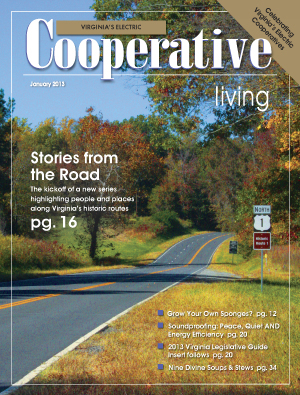
Travel Archives  For those of you who are mainly followers of the wacky musings on this blog and not my more conventional fare, it may interest you to know I actually earn a living as a professional journalist, too. And occasionally, I get paid to do things that are loads of fun–like write columns about road trips. If travel floats your boat and, like me, you’re more interested in local color than necessarily hitting all the high points of a particular place, then check out my new “Stories from the Road” series, a monthly column in Cooperative Living magazine that launched this month.
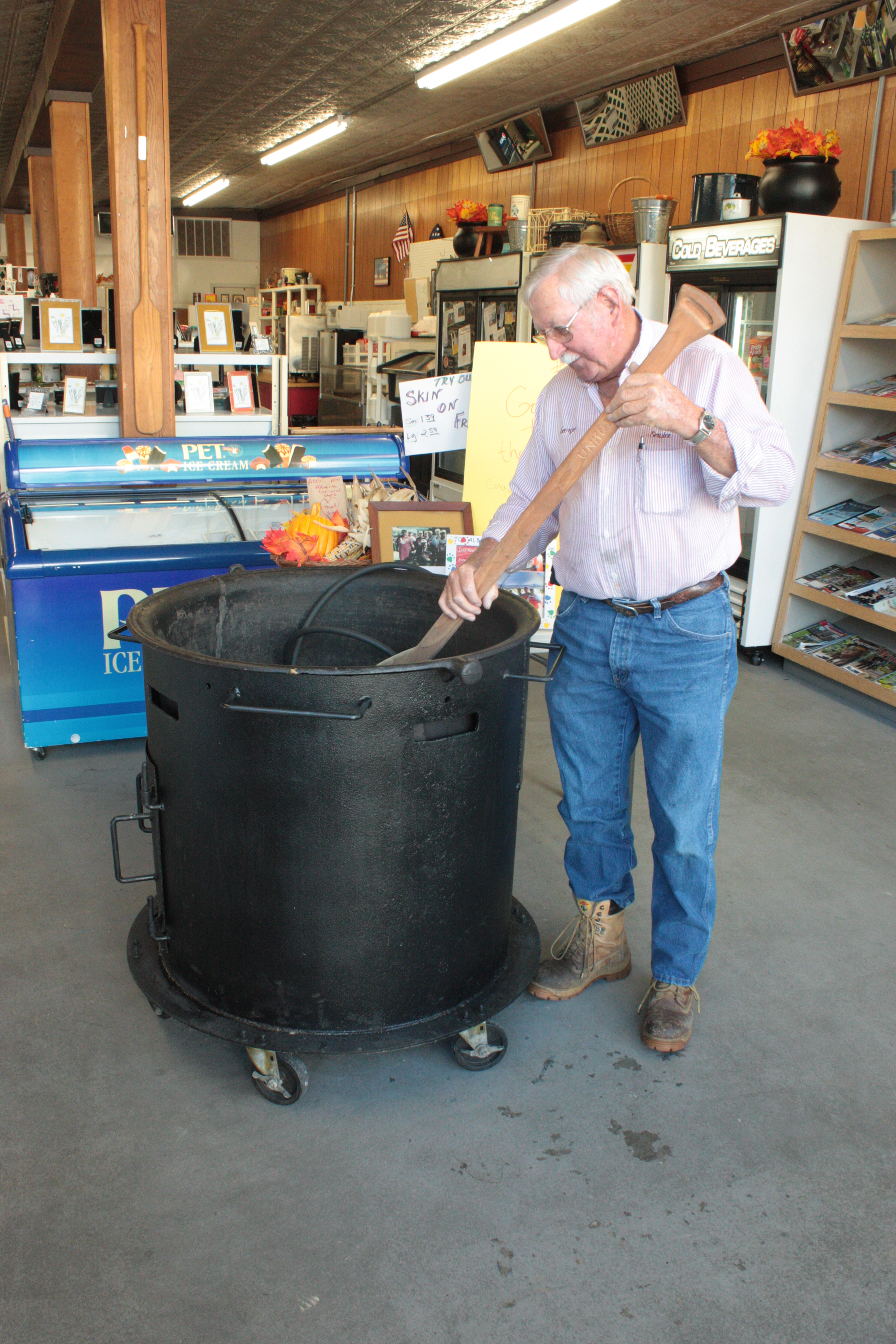
In the January issue, I chat with Brunswick County, Va. stewmaster Col. George Daniel, who dubs himself “the Dale Earnhardt of the stew crews.” That would be the stew crews who participate in the annual Taste of Brunswickheld each October just off old Route 1 near Alberta. “I rag on everybody,” says Daniel, and it’s easy enough to believe. His Red Oak Stew Crew has been champion of the event many years running.
The Dale Earnhardt of Brunswick Stew: George Daniels
If you’d like to taste some Brunswick stew in Brunswick County, head to the Alberta General Store, the centerpiece of a one-dog town where you’ll find the heights and weights of local children recorded on a support post at the back of the cafe. “Uncle” Chuck Johnson is the stewmaster here, and he serves up a mean bowl…though not as good as Daniel’s…at least that’s what Daniel says….

Making dreams real with some fireworks and electric sparks at Cinderella’s castle
I often wonder how many of us have been screwed up by Norman Rockwell paintings…like the famous family Thanksgiving picture with all the smiling faces, multiple generations gathered around the holiday dinner table. If our holiday dinners don’t look this way (which they rarely do unless you can convince a dozen cranky people to fake it really hard), we get depressed, believe ourselves failures at life (or at least family life), and fall into funks from which the typical American rescue is a bottle of Lexapro…or maybe Wild Turkey. (Depends on the family.)
Norman Rockwell meant well, I think. As did Walt Disney when he began building the famous theme parks that draw families by the millions each year. I doubt it was the intent of either to set up unrealistic expectations of joy to which we relentlessly aspire with very little real hope of attainment. Yet that is what they have done.
I attempted the Disney dream with my five-year-old daughter this Christmas. It was, in part, an attempt to escape the family holiday dinner table with all its barely suppressed tension and disappointment in exchange for a Christmas that looked nothing like Christmas, nothing like a Norman Rockwell painting, nothing like anything that could possibly make me compare my life to a dream I can’t say as I’ve seen anyone I know fully attain.

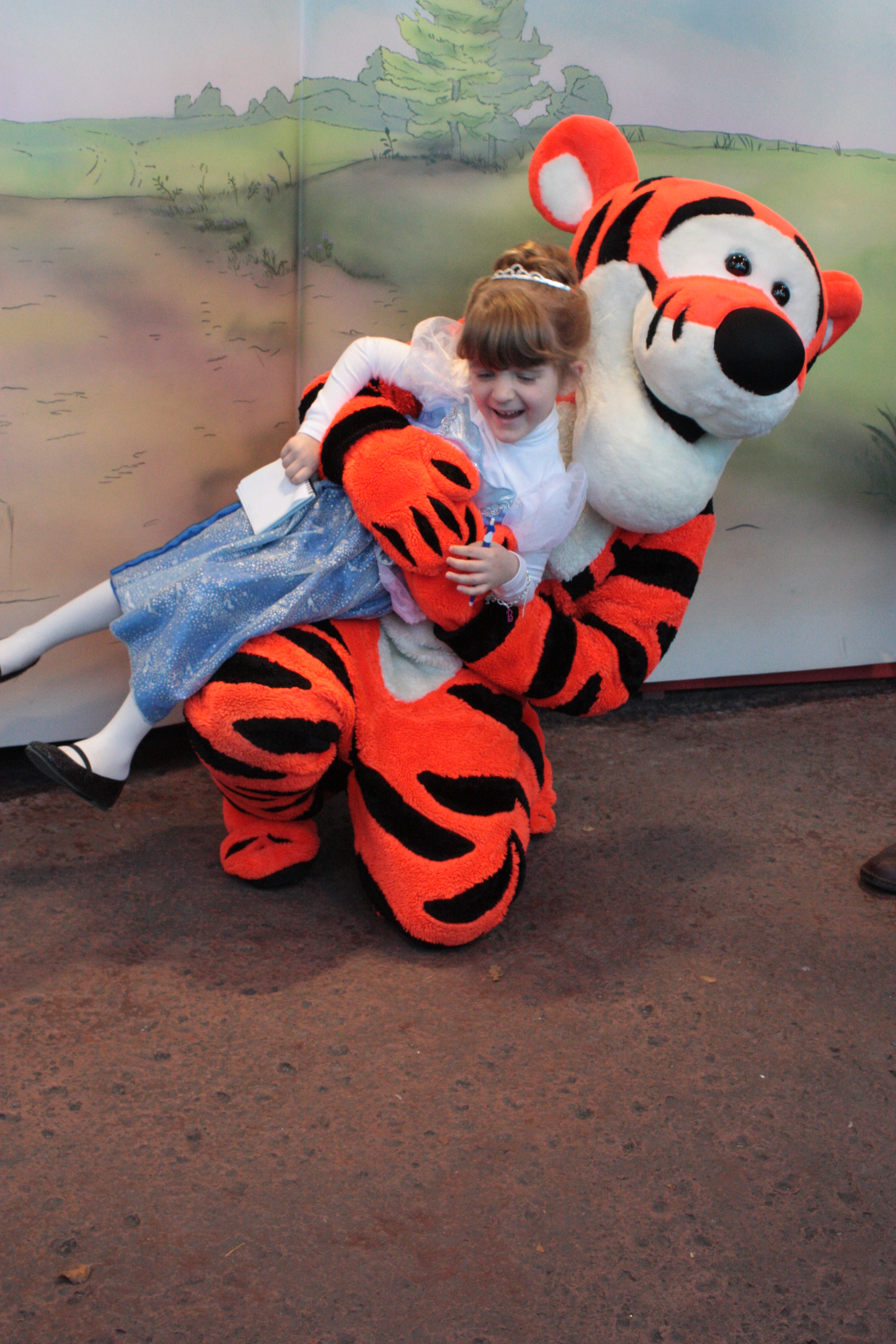
My daughter clowning around with Tigger at the Magic Kingdom
And besides, we all grow up with visions of Disney World as a magical place filled with fun, and joy, and laughter. Where these visions come from, I don’t know. I think they’re from the same place that sends visions of early parenthood as some period of deep happiness where Mom and Dad share the delightful responsibility of changing diarrhea-laden diapers at 3 a.m. and manage to smile through the whole smelly, sleep-deprived process.
So many parents with whom I was acquainted had encouraged me to take Heidi to Disney, insisted now was the time while she would still think all the princesses and residents of the Hundred Acre Wood were real. And I’d seen their Facebook posts and pictures of their own Disney trips, and somehow, I admit, I was taken in.
But once I began reading the 700+ page, Bible-thick Unofficial Guide to Disney and downloaded all its suggested apps, I began to worry. This was like planning battle strategy—hit this ride at this time to avoid a 180-minute wait. Get a Fastpass for Dumbo, and then go see the Mickey Philharmonic, and make sure to be back at your designated time for your 30-second ride aboard the floating elephant.
Don’t get me wrong. My five-year-old had a blast. And thank heaven for that. Else I would find it incredibly hard to justify the 25 miles or so I walked on hard pavement day after day pushing a Minnie Mouse stroller designed for short parents, carrying a 30-pound backpack, while plotting Magic Kingdom battle tactics on my Droid.
At first, I thought maybe I was a grumpy parent, that something was wrong with me. Why was I not loving Disney??? It was the same line of questioning I engaged in as the mother of a newborn. Why don’t I love every minute of the smelly diapers, the breast milk vomit on my shoulder, the 48-hour marathon runs of screaming diaper rash?
When I began berating myself over the phone to a friend, he said, “You do realize all those other parents hate it as much you, right?”
Um, no, I didn’t realize that. If that’s the case, why do millions of people descend on the park every year?
Because they’re buying into the Disney dream…in the same way we buy into the American Dream. Get everything you want, and then you’ll be happy. Make a wish, throw some electric sparkles into the air, and everything will be perfect ,and the wicked witch or Captain Hook will run away.

One dream come true: a grateful five-year-old
Don’t get me wrong. I believe in dreams, probably more so than the average person who has had the intelligence to give up on the impossible before divorcing twice and switching jobs about a dozen times. But Disney isn’t really about dreams, at least not the kind that are achievable when you make less than $1 billion a year. All Walt Disney has proved is that if you throw enough hard cash at something, you really can make the impossible real. Bill Gates and Steve Jobs have done the same thing with a lot less plastic and electric hoopla.
And after a few days at Disney and a fair amount of eavesdropping as well as philosophical chats with parents stuck in the same two-hour line with me waiting for photos with Princess Merida, I began to see that I was not alone in wanting this active vacation for couch potatoes to end as soon as possible.
While walking down a beautifully manicured path in the Animal Kingdom, I overheard a mother say to her teenage daughter, “I haven’t been here in 10 years, and I don’t think I’ll be back for at least another 10.” Dragging her feet and sighing, she continued, “This place is a mess.” (She was referring to the crowds and the spectacle, mind you, not the trash. Disney hires a massive cadre of folks who spend their days sweeping up every scrap of paper and displaced water bottle within three seconds of them hitting the ground.)
I found myself commiserating with mothers pushing baby strollers who wanted nothing more than to get back home to Nashville…and London (and why would you fly across the Atlantic to see this place???) I listened to fathers snap at their sons, “Enough already. No more whining, no more talking, just be quiet.” I heard moms and dads bickering on the ferry boat departing the Magic Kingdom, perfect fireworks blasting off in the background over Cinderella’s Castle. But was anyone watching them? No, just Heidi and me. Everyone else was facing the exit sign for the ferry, anxious to get off, get home, and put the Disney dream behind them.
My ex-husband told me I should take Heidi here again one day, maybe when she is 21, to let her “relive the magic.” I actually guffawed. If my daughter can think of nothing better to do with her 21st birthday than go to the plastic kingdom, I have done a poor job of raising her. African safari, kayaking Norwegian fjords, hiking the Great Wall—any of these requests I’m willing to consider. But not Disney World. Never again.
You see, I’m all about magic…real magic. The kind you find when rafting down real whitewater on the New or Colorado Rivers, not some fake river flowing through the Animal Kingdom.
It might have been worth it to see Heidi dance with Tigger in full delight or wrap her arms around Minnie Mouse’s waist. But you know what? She was just as thrilled last fall standing under the largest intact T-Rex skeleton in the world at the Field Museum in Chicago and posing in front of a giant Brontosaurus’ thigh bone.
But the really tough thing about Disney is the way it distracts. It distracts so intensely that the families visiting forget everything but checking off all the rides on their list and getting the autographs of all the “characters” for their six-year-old. It’s not like gliding into Glacier Bay on a kayak or slipping down the canals of Venice on a gondola where you experience take your breath away spectacle of an all-engrossing, thank God I’m alive and breathing and seeing this kind.
By my last night at Disney, I’d had quite enough. Tired and cranky as a toddler, I was trying to push Heidi’s stroller through a mob scene watching the nightly Electrical Parade at the Magic Kingdom. When a “cast member” chastised me for stopping the flow of traffic so my little one could get one last glimpse of Mickey gliding by on a float, I turned on her with all my Disney angst and let loose a flood of not epithets but something close. Needless to say, she left me alone, and I knew suddenly Disney was not the place for me anymore than a cage in a make-believe Serengeti is any place for a warthog.
I still don’t plan on spending Christmas anytime soon trying to create a Norman Rockwell painting in my dining room…but I sure as heck won’t be watching pacing tigers in “Asia” who are trying to figure out how to break through the glass wall that separates them from the tourists they’d very much like to eat. I’d rather see the tigers where they belong…in India…and myself where I belong, too—in a setting where magic is real and doesn’t require an electrical cord to make it run.
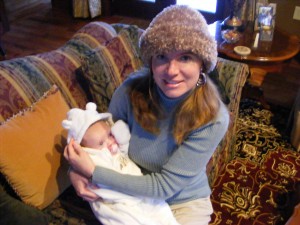
Two months into new motherhood: recognize that “deer caught in the headlights” look?
It was almost like I was meant to read Mel Robbins’ column in the August issue of SUCCESS magazine. It was the night before my (ex)husband and I were to finally sign the separation agreement that would formally end our association as husband and wife and dissolve any claims we might have on one another. It was 11 p.m. I picked up the magazine there on the ottoman, flipped through it, and landed on Robbins’ essay,
“Fight For Your Happiness.”
I wouldn’t say I needed to read Robbins’ column that night. My days and nights of soul searching were long passed. In fact, they had passed a good six months before I even asked my husband for a divorce. But her essay verified for me what few people, particularly unhappily married ones, are willing to acknowledge—that holding a doomed relationship together for the sake of the kids is…well…perhaps among the worst things you could do to your children.
I wasn’t having any cold feet, mind you. But sometimes it helps to know you’re not a lone wolf in the wilderness. In her column, Robbins talks about a close friend who decided to leave her marriage of 23 years. The friend’s announcement came as a shock. As Robbins points out, the couple had highly successful careers, three children, a beautiful home, took fantastic vacations together, and had lots of money. Their life was perfect…or, as is so often the case, it appeared so.
Robbins notes of her friend, “Inside, Lisa felt miserable. She and her husband had become roommates—they hadn’t touched one another in years. She laughed less and less. She gained 30 pounds.” The only thing they had left in common, Robbins says, was their three children.
So the two decided to divorce, and their kids said, “Now everything makes sense.”

Our first getaway after Heidi’s birth…and the last photo where the smiles are real.
What struck me about “Lisa’s story” was how similar it was to my own and how similar it is to that of so many people I care about. While some might read Robbins’ essay, which encourages readers to make the hard changes that ultimately lead to joy, as a call to action, I read it as a cry for honesty.
We may laugh about the old adage of “keeping up with the Joneses.” But most of us do it even as we recognize we’re doing it. The big question here is: WHY?
I’m not sure I have the answer. I’m no better than the average–I probably hung onto my marriage years longer than I should have. I recognized it was moving onto the rocks even before my daughter was born, and there’s nothing like bringing a child into the world to make a rocky coast even more treacherous. I’ll never forget our first Thanksgiving after Heidi’s birth. She was two months old, and my best friend, who was single at the time, joined us for the holiday. After we’d cleaned up dishes from the noon meal, she said to me, “I want to have a happy little family just like yours, Debbie.”
Full in the throes of postpartum depression, a newborn on my hip, my business running at full throttle, and my active duty Navy husband rarely in the picture, I was floored by her statement. I was at one of the lowest lows in my life.

A moment of “for the camera” bliss on the Cayman Islands.
I failed to notice, however, that to anyone on the outside looking in, my life looked grand. A year earlier, I had completed construction of my dream house following marriage to my high school sweetheart. My business was growing by leaps and bounds, gross income doubling every year. Things were so good, in fact, that eight months after Heidi’s birth, her dad retired from the military, and we lived secure in the fact that we could more than manage on one income. To celebrate his retirement and the newfound freedom of our lives, he and I left Heidi with the grandparents for three weeks and went on a luxurious nearly month-long vacation—a week in the Florida Keys, a week in the Caribbean, and a week lounging around on Sanibel Island. We would follow that up two years later with a trip through Northern Europe, and every October, we rented a house on the northern Outer Banks for a week in celebration of Heidi’s birthday.
This was life at its very best, yes?
Hardly.

The “perfect” family Christmas portrait.
As is so often the case, what is visible on the surface is hardly indicative of what lies beneath. Behind all the smiling photographs of a perfect family life, things were not so wonderful. Today I look at professional photographs from the Christmas after Heidi turned two and am amazed at the happy expressions on my face…on my husband’s face. As I finished dressing into black velvet for the occasion, he told me he wasn’t going to participate in the photo shoot because it was a farce. And he was right. It was. He and I were no more in love at that point than a cow is happy to eat a patch of crown vetch. But I finally convinced him to play the game. The result? Falsely blissful Christmas photos for posterity.
If this sounds familiar, just wait. It gets better.
When I complained, about two years after Heidi’s birth, about the wreck of my marriage to a close friend, she puzzled over what to do. She believed, the child of divorced parents herself, that maintaining the family unit was critical. After a few moments of consideration, she said, “Have you considered having an affair?”
Had it indeed come to this?

Heidi and her dad during the family’s annual birthday beach getaway.
Yes, it had. And I spent the next two years of my life trying to decide if I was doing my daughter any favors by maintaining a marriage with a man I no longer loved.
Because what I had to consider was whether or not it made a difference if my husband and I rarely showed affection in front of Heidi, whether or not it mattered if family dinners were typically strained and difficult, whether or not my daughter would adopt all of this lack of intimacy and tenderness between her parents as a confirmation of its “normalcy.” Did I want her to grow up and settle? To say to herself “Well, I guess this is how love is; I guess this is what marriage looks like.”
Was it going to benefit my daughter for me to “fake it” with her dad for the next 12 to 15 years?
I ultimately decided the answer to that question was a resounding “no.”
I had decided that the best things I could give my daughter were my honesty and my happiness. And if I gave her those two things, it would likely also increase my chances of finding love that was real…because I was about to be real, to stop the charade of the perfect life I’d been carrying on, well, since early adulthood at least.
And what does real love look like? Well, as a friend of mine said recently, “Real love sure as hell isn’t something you can clock in or clock out of.”

Honest joy at last: On the Skydeck in Chicago with my daughter one year after “the end”
Yet that’s exactly what my ex and I had done. And it’s what thousands of other couples do every day, denying each other intimacy because it’s inconvenient, because they’re busy, because they’re hurting and don’t want to hurt anymore, because they’re afraid. So they give and receive love when it’s comfortable and deny its dispensation and acceptance when it’s not. And eventually, love is gone completely…if it ever really existed in the first place…because it has lived like a houseplant that everyone keeps forgetting to water regularly.
And when a relationship reaches that point of dryness and wilt, it’s typically very hard to save.
But that doesn’t mean one has to give up and settle for a life that looks perfect but sure as hell isn’t. As “Lisa” discovered, you can always choose happiness. And you might even find yourself surprised by how that choice our culture so often deems selfish (probably because so much of the culture lives with its absence and so must justify it) changes not only you…but the people you love.
The same friend who cautioned me against the dangers of “clocking in and clocking out” on love has had no easy ride in this life, but, as Robbins noted in her essay, happiness is not always the easiest choice to make. Sometimes you have to fight for it. My friend did, and he lives by his own special creed on this one: “If I have lived my life without happiness, I have lived it in vain.”

One of my best holiday memories: Thanksgiving with my oldest friend and chosen “sister”
As I write this, people everywhere are suffering. Even among my small circle of acquaintance, the trouble is great. One of my colleagues is watching his life partner, who was first diagnosed with breast cancer, now struggle with cancer in her bones, lungs, liver, and abdominal cavity. Another friend is watching an old school friend fight for his life to recover from cardiac surgery. Meanwhile a dear friend’s boss and his wife try to cope with the loss of a child, and one of my clients is about to see her husband go into surgery tomorrow to remove a cancerous tumor from his kidney.
This is just the tip of the iceberg.
My oldest and dearest friend and I talk almost daily about the trouble in this world, how a day does not seem to go by where someone we know and care about is not struggling. And we talk, too, about why life has to be this way, why it seems to get more and more heartbreaking the older we get.
We are in our mid-30s, part of that unenviable “sandwich” generation, caring for young children, caring for ailing, aging parents, watching our friends and acquaintances struggle with their first signs of the onset of deteriorating bodies and lives. Illness, death, infidelity, divorce, births, neuroses—we are watching it all like a grand drama here in our own lives.
It is hard sometimes not to feel hopeless.
“I think it’s only going to get worse,” Sarah confides to me one night.
“I think you’re right,” I agree, realizing that despite everything we’ve been led to believe, life does not get easier with age and wisdom.
When she tells me about one of her friends who just lost her mother and sister in the last year, then struggled with her husband being in the ICU on the brink of death for weeks, only to lose a son in a car accident shortly after her husband came home, I tell her, “She should write a book.”
“About what?” Sarah asks.
“About how she has survived it,” I reply, thinking I would surely drive my car into a tree if so much tragedy befell me at once.
“Her women friends,” Sarah tells me. “That’s how she says she has gotten through.”
It might strike some people as odd that the woman did not say her family had pulled her through, so enamored are we as a culture with the idea that families are the be all and end all of existence. But that, as I and many of my women friends know, is, more often than not, a tragic myth.
Years ago, a couple I knew lost a son who was in the military. Always the loving pair with a big happy family (they had three other children) to outside eyes, this death tore them to pieces. One grieved with tears and talking; the other withdrew. They did not understand one another. Their more than two-decade old marriage dissolved within the year.
Why do families so often fail at love in the most critical of times?
It is a question to which I do not have the answer, though I have seen it often in my own life and in the lives of the people I love most dearly in this world.
Mark Twain once quipped that “familiarity breeds contempt,” and that may be true to some degree. But perhaps the greater truth is that the loving family that stands by us through thick and thin is as much a myth as Prince Charming and “happily ever after.” Yet we buy into it nevertheless, wondering what is wrong with us when our spouses, children, parents, aunts and uncles don’t provide the succor we need in times of crisis.
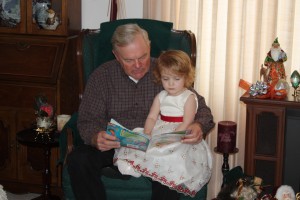
Taking a break from the dysfunctional family Christmas: my dad and Heidi
An acquaintance mentioned to me recently how his parents had this grand idea of having a summer family get-together where everyone stayed in a rented vacation house for a week—parents, kids, grandparents, sisters, brothers…everyone. “They think it’s going to be some big happy family,” he remarked. “But it’s never been that way, and it won’t be this time either. That’s just not how we roll.”
I don’t know if it’s how anyone rolls, to be quite honest.
We don’t choose our families, not really. We may get to choose our spouses, but most of us are so young and stupid when we do that that we might as well be picking out the cutest puppy at the pet shop on a whim of temporary adoration. It’s difficult to ask people whom we have not chosen and who have not chosen us to give us their all. Maybe they don’t like us. Maybe we don’t like them.
The old saying goes, “Blood is thicker than water.” I don’t know if that’s true. When one of my friends tells me my mother is crazy, I reply, “Yep, you’re right.”
And then I thank heaven for my friends. If I had to rely on my family to get me through the tough times, I’d be in dire shape.
Ironically though, it is with our disgruntled families that most of us spend our precious free hours—our vacations, holidays, birthdays. What should be the happiest days of our lives are peppered with disappointment, disillusionment, and sometimes even verbal brawls because we try to impose our vision of “the family” onto a group of people who maybe really don’t have a damn thing in common other than a blood line.
I know a handful of people who have made a stand against the drama. One couple I know who found each other late in life skip the family drama entirely for the holidays and have all their close friends over for Christmas dinner instead. I also have some friends that hold a “dysfunctional Thanksgiving”—a gathering of friends who have eschewed their relatives for this iconic American holiday.
I’ve decided it’s high time I do the same. This year I’m skipping Christmas. I have a long history of dysfunctional holidays that I’ve decided it’s high time I put in the past. From relatives who get into tear-inducing fights post-Christmas dinner to stressed out women who cook and bake for days out of obligation instead of love, I’m fed up. I’m taking my daughter to Disney World. And given my low tolerance for mass consumerism and waist-high people, it’s a grand testament to just how fed up I am.
Maybe one day when all the relatives who drive us crazy are gone and we’ve all divorced and remarried to people we actually like, my friends and I will join together for holidays we can actually enjoy among families we have chosen. Until then, do not be surprised to find me on a beach halfway across the world come Christmas and New Year’s…with no blood relative in sight, save perhaps my daughter.
Because life is too short to spend it being miserable among people who no more want to be with us than we want to be with them.
Posted by Deborah Huso on Oct 14, 2012 in
Men,
Motherhood,
Musings I spend a lot of time in airports. And if you really want to get the pulse of human nature, there is no better place to find it than in an airport–or on an airplane–in the rush to board or deplane. This is where people show their true colors. And the colors are not pretty. We’re not talking sunny yellow and soothing insane asylum lavender (which is, by the way, the color I painted my office). We’re talking angry orange and dire black.
I can’t tell you the number of times I have lifted heavy suitcases for pregnant women when plenty of able-bodied men were about. Or the number of times I have seen elderly ladies taken out by the roller suitcases of businessmen. But a recent tripped to Chicago topped it all.
I was suffering from a minor wrist injury and had my right hand in a brace when my five-year-old daughter and I boarded a plane in Detroit on leg two of our trip home. When I struggled a bit trying to get my suitcase in the overhead bin with a bum hand, Heidi called out from behind me, “Can someone help my mommy, please?”
Nothing. I dropped the suitcase. Heidi repeated her question in a plaintive voice four more times with no reaction from any of the passengers seated around us. I looked down the aisle and met the gaze of a flight attendant. “I’m sorry, but I have bad hand,” I said to her. “Could you help with this suitcase?”
Remarkably, she shook her head and turned away. (And in case you’re wondering for the sake of future flight planning, this was Delta.)
Then what I can only admiringly call a “bad ass grandma” appeared behind Heidi. Petite but feisty, she said loudly, “I cannot believe with all the men on this plane, not a one can get up to help you put that suitcase away!”
Still there was virtually no reaction from anywhere, save first class. A young man from business class finally met the call to action and stowed my suitcase for me.
Next item: climb over young businessman to access my window seat. He was sitting there in his aisle seat engrossed in his iPhone. With my good hand clutching the fingers of my energetic preschooler, I said, “Excuse me.”
No reaction.
“Excuse me, sir.”
Still nothing.
I was beginning to think I was the victim of some horrible practical joke. I knelt down to put myself at eye level with the seated businessman glued to his handheld electronic device, and said, “I’m sorry, but I have to sit beside you. Could you please let me in?”
That finally worked. He got up and let me in.
Once I had Heidi and myself buckled into our seats, I sat there wondering over this latest experience of human decency gone awry. I don’t expect too much of people, men in particular. I’m a self-made businesswoman who knows how to wield both a weed whacker and an orbital sander. But just because I can do everything most of the time when required does not mean I do not appreciate acts of basic human kindness.
Like men who open doors for me. Or young people who offer to hoist my luggage into the overhead bin on an airplane.
But basic human kindness has become an increasingly rare commodity. When a man holds a door for me these days, it almost bolls me over so rare is the occurrence. And when a businessman in an airport actually lets me go first to get off a plane rather than running me down in his mad rush to get to wherever, I find myself pleasantly surprised.
But I don’t think this is how things should be. Fellow contributor Susannah tells me she thinks the trouble is that men are scared to be kind to women because there are women who are offended when a man offers to carry their bags or pay for their dinner.
Um, really?
Who are these women?
I’m a feminist. I believe I can do whatever a man can do for the most part, though there are some areas where I fail. I can’t, for example, swing an ax for hours on end. But I suppose if I really wanted to be able to swing an ax for hours, I could build up the strength to do it. But just because I am smart and capable doesn’t mean I don’t ever want a gesture of respect or assistance. I am human, after all. And I have to wonder about women who take offense when a man commits an act of basic human kindness.
I really don’t think this is the problem. What woman in her right mind would get annoyed if a guy opened a car door for her or bought her dinner on a first date? It is no different from when I help an elderly woman find her seat on an airplane because her eyesight is no longer so good. It’s a small matter of honoring one’s fellow creatures as human beings deserving of care and respect.
I don’t believe men are the problem or feminism is the problem. I think our culture is experiencing a disturbing decline in basic human decency, and I wish I could pinpoint the answer as to why.
I cannot.
I just know it has reached epidemic proportions.
The one advantage to all this rudeness, however, is that it provides an excellent filtering system. For example, if a man fails to open a door for me or fails to buy dinner on a first date, that’s it. He’s done. And if an acquaintance fails to show proper empathy for a friend or colleague in need of comfort, I know instantly that person is not worth my time or energy. The playing field of people who understand basic human kindness and basic modes of showing respect has narrowed so much that it’s become quite easy to dismiss potential friends, lovers, and colleagues as complete duds on first acquaintance.
But the question remains–what is going on here? It wasn’t so long ago that a person who did not help an elderly neighbor with her groceries, hold doors open for women and old folks, and at least offer to foot the bill at dinner gatherings would be socially rejected as a numbskull. But now it’s perfectly acceptable, apparently, to be rude and self-centered.
I had the pleasant experience this last week of having a door held for me by my 10-year-old second cousin in Chicago. “After you,” he said. And when he and his brother received gifts of soccer jerseys from Norwegian relatives, without any prodding from their parents, they put them on and then pleasantly posed for pictures from trigger-happy relatives with cameras who thought they were cute. These young men will be rare commodities, I fear.
Decency isn’t that hard a skill to master. You would think otherwise though by how many people lack it, of course. As Susannah, who is training her 10-year-old son in the arts of social grace, says, “It’s really not that hard to hold a door open and say, ‘How are you?’ It should be a social reflex.”
Unfortunately, it’s not.
The social reflex these days is to ignore your surroundings and scroll on an iPhone while buildings burn and women give birth in the aisle four feet from your airplane seat. Oh yes, and you’re an M.D., too, but let’s just forget that for right now, as it would be awfully inconvenient to offer your expertise and aid on your vacation trip to Panama.
The problem here with this “ME” attitude, however, is that it isolates. And, as any history major knows, isolation only leads to a dangerous disconnect from reality and society.
If you don’t offer yourself to others, they sure as hell are not going to offer themselves to you.
So next time you see a single mother struggling with a stroller, three suitcases, and two toddlers, offer a hand. Because the thing about basic human kindness is this: just like the more popular mode of toxicity, it’s contagious as hell. Make a mom smile, and you’ll smile, too. And honestly, wouldn’t you rather see O’Hare or Hartsfield-Jackon as places of opportunity rather than places of massive rush and stress. Care for your fellow man, and I guarantee, in times of trial, he will return the favor.