Posted by Deborah Huso on Mar 10, 2011 in
Travel Archives 
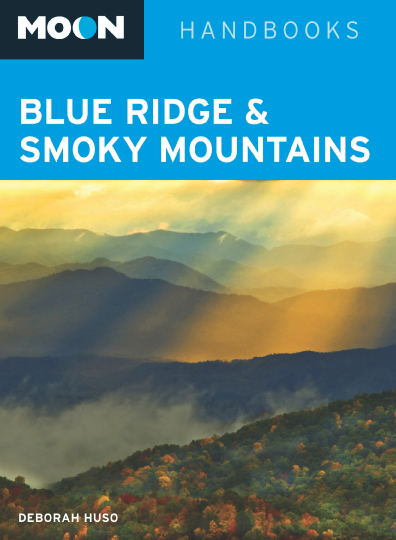
Moon Blue Ridge & Smoky Mountains
If you’re visiting the Highland Maple Festival this year in beautiful Highland County, Virginia, the weekends of March 12-13 and March 19-20, you’ll be touring my home stomping grounds. If you’d like to pick up a copy of my latest travel book, the first edition of Moon Blue Ridge and Smoky Mountains, you can find signed copies available at Artful Gifts on Main Street in Monterey or at Country Convenience, a classic old-time country store in Blue Grass. Published by Avalon Travel, publishers of the popular Moon Handbook as well as Rick Steves series, Moon Blue Ridge and Smoky Mountains is the independent traveler’s guide to the Blue Ridge Parkway and Great Smoky Mountains of North Carolina and Tennessee.
Posted by Deborah Huso on Jan 21, 2011 in
Travel Archives
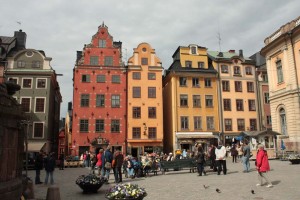
Stortorget, Gamla Stan's oldest square
The first thing to know about Stockholm is that it can’t be done in a day. So just forget it. You’re going to have to focus. If you want to get the most bang for your time, however, then that focus should probably be Gamla Stan, the city’s Old Town. And this is especially the case if, like me, you have come to this city for the architecture.
Stockholm is a beautiful city no matter where you go, and when I take a 20-minute ride on a city bus to the medieval Old Town, I’m already salivating just looking out the window, where almost every building that flashes by looks like a work of art. But when I step off the bus in Gamla Stan, and find myself looking up at the narrow wrought iron spire of Riddarholmen Church, the oldest surviving church in the city, I feel momentarily dumbfounded. Built in 1270, it is the final resting place of Swedish kings and queens, the first king having been buried here in 1290.
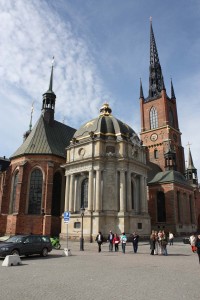
Riddarholmen Church
Such deep history is common here in Stockholm’s oldest island quarter, and I wonder if I can do it justice in the limited space of a single day. Thankfully, Gamla Stan is small and walkable, replete with narrow cobblestone streets (that Swedes are able to drive on quite remarkably) and Medieval architecture framing the scene around every corner. Founded in 1252, Gamla Stan is one of the best preserved Medieval city centers in Europe situated in the midst of the 14 islands and 57 bridges that make up this Scandinavian “Venice of the North.”
No tour here would be complete without a visit to the Stockholm Cathedral, originally constructed in the 13th century, though its current incarnation reflects the Baroque architecture of the 17th century. The local parish church for Gamla Stan, this is where Sweden’s royals are married, the most recent nuptials having taken place here in June with the wedding of Crown Princess Victoria to Mr. Daniel Westling. The Swedes love their Royals almost as much as the British do, and images of them can be found in every gift shop in the city.
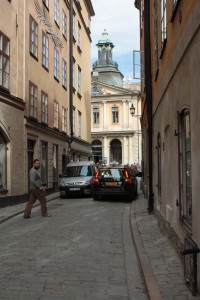
Yes, they passed one another...just barely
I decide to get a taste of Royal Swedish life by visiting the Royal Palace, the official palace of the Royal family. The palace as it exists today was completed in 1754, and most of the interiors reflect the tastes and styles of the 18th and 19th centuries, though there are several rooms featuring elaborate Baroque style ceilings rich with a mixture of paintings and sculpture that meld into one another like a 3-D landscape. The palace also has its own Hall of Mirrors modeled on the one at Versailles. The palaces are typically crowded with visitors, particularly during the changing of the guard and in the Royal Apartments. But among the best places to visit in the palace complex is the Royal Armory with its collection of coronation coaches, personal armor, christening cradles, and royal wedding attire.
You can make a day-long tour of Gamla Stan especially easy (and cheap) through the purchase of a Stockholm Card, which provides free access to all the historic buildings, museums, and also free transportation, including use of the city’s Hop-On Hop-Off boats, which ply Stockholm’s waters, providing tourists easy access to attractions all over the city, including the Vasa Museum, home to the world’s only surving 17th-century ship.
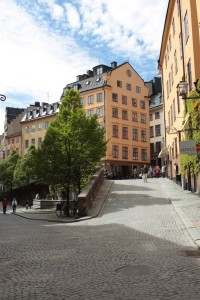
The beautiful streets of Gamla Stan
Wondering where to grab a bite to eat? It’s rather hard to go wrong here with so many lovely cafes fronting the cobblestone streets, but if you happen to tour the Nobel Museum, consider lunch at their Kafe Satir, where all the chairs have been signed by Nobel laureates. The food is divine–oozing Swedish sandwiches loaded with meat and cheese accompanied by a salad bar, flat bread slathered in butter, and some divine pastries. And the best thing is the fare is inexpensive. Two can dine here for lunch for about $20 USD, and if you know anything about Scandinavia, that’s a steal.
Posted by Deborah Huso on Jan 3, 2011 in
Writer Rants So we all know The Huffington Post is able to turn a profit because it doesn’t pay its contributors. Now Forbes is looking to do the same…on a whole new scale. Not only does the company have plans to use the works of thousands of unpaid bloggers to build the content for its site, but it then plans to turn around and sell the works for which it has not paid. Yes, you read that correctly.
Now imagine for a moment how successful a typical company would be if it failed to pay its employees. How many would give it their all? I daresay very few. Why does the media world think it can operate by different rules? Probably because there are countless writers out there willing to work for nothing, a concept I’ve personally never been able to grasp. But then I have bills to pay.
In one of his latest blog posts for BNET, “Forbes.com: Don’t Steal Our Content. We Took It Fair and Square,” a post for which I’m certain he received compensation, Erik Sherman writes, “Forbes can take any free blog material and use it in any of its magazines or give permission to any other publisher that has licensed the Forbes name. It can sell rights to others to use the blog posts and also sell reprints. These rights last forever and extend to all wireless and mobile. And the writers get nothing.”
Now in case you are not familiar with U.S. Copyright Law, let me give you a quick civic lesson: the fundamental ideals behind copyright law are to give creators rights and control over their work, the ability to earn income from it, the idea being that if we creators have an economic incentive to create, then we’ll create more, thereby promoting knowledge in the universe.
Take the creator’s right to earn his bread by his work away, and what do you have? Well, you certainly don’t have a full-time professional writer. I can tell you that. And why do you want one? Well, it’s pretty simple. I certainly don’t want Joe Neighbor giving me the scoop on what’s happening in Afghanistan anymore than I want the ghostwriter for GM’s CEO writing content for Forbes.com. Journalism is supposed to be objective…and factual.
Sure, there are some conscientious writers contributing to these “salary-free” sites, but they are few and far between. Most of us can’t afford to be conscientious for free. Like normal people who get paid to go to work every day, writers have families and mortgages, too.
This is not to say I’m arguing here for the poor, unpaid writer to get paid. If you’re writing for free for Forbes.com or anyone else for that matter with the idea you’re going to get your big break one day, I’ve got news for you: you’ll likely wait till you starve to death. What concerns me and what has consistently concerned me on these pages is the continuing “dumbing down” of the universe.
Would you want an unpaid mechanic working on the airplane on which you’re about to fly cross-country? Would you want an unpaid surgeon putting a pacemaker in your dad’s chest? So why are you reading “news coverage” provided by unpaid journalists? Is truth cheap? Somehow, I don’t think so. But bunk sure is.
Posted by Deborah Huso on Nov 29, 2010 in
Travel Archives  If you’re looking to add a little extra twinkle to your holiday season, consider a December weekend getaway to Helen, Georgia. Nestled in the Chattahoochee National Forest a couple of hours north of Atlanta, this recreated Bavarian village is something of a winter wonderland this time of year with its towers and turrets bedecked in white lights, polka music filtering out into the streets, and its scenic location along the slowly meandering Chattahoochee River. You can read all about it in the December issue of Disney’s FamilyFun in my latest travel article, “Spend a Day in Helen, Georgia.”
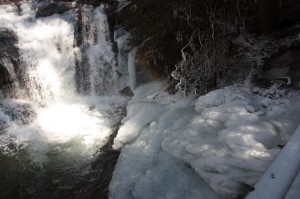
Dukes Creek Falls
Of course, there were a ton of things that didn’t make the editorial cut, including the steep (on the way back) but lovely hike to Dukes Creek Falls, a double waterfall near Helen that, in winter, is half frozen. It is perhaps not as startlingly beautiful as the more popular and accessible twin falls of Anna Ruby, but you won’t meet a soul on this trail…not in December anyway.
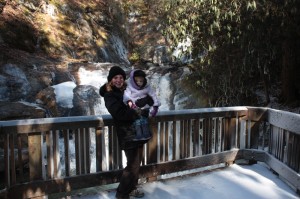
Heidi, already an experienced hiker at age two
While my suggested itinerary in FamilyFun is focused on what to do with the kids in tow, be sure to pick up a copy of Blue Ridge Country in July for a very adult itinerary for the lovely mountains of North Georgia, as I take you on a tour of the region’s best wineries and waterfall hikes. Just make sure you hike before the wine tasting….
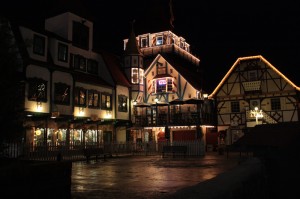
Helen after dark
Posted by Deborah Huso on Nov 13, 2010 in
Travel Archives 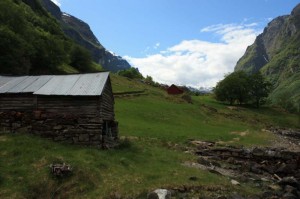
The farm near Gundevagen that served as our Fjord Norway headquarters
It was my husband who nudged me out of bed at 4:30 a.m. on a chill June morning, the sun already shedding a gray light over the tops of the fjord walls, striking the waters of the Naeroy Fjord a deep metallic blue, the goats (or sheep as our host called them) neighing already, the low tinkle of their tin bells rousing ravens from rest, who came, as they had each morning of our stay here south of the famous Sogne Og Fjordane, to beat their wings against the glass of the kitchen door. They ensured, along with the never darkness, that I would not sleep this whole visit. But it didn’t matter because I was endlessly awake—the persistent daylight keeping me roused, this strange Norwegian landscape that let me read books till midnight by the light of a window.
Something made me not want to get out of bed, uncomfortable as it was this narrow cot in an old farm cottage. Perhaps it was the desire to perpetuate a little longer the sense of not quite being there yet, not quite being in the place where history for me began.
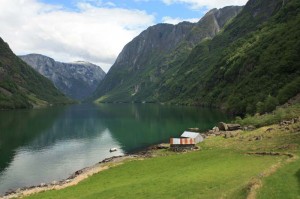
View of Naeroy Fjord from Ramsoy Farm
But I knew I had to rise. We had a roundtrip journey of some 700 kilometers ahead of us, a five-hour drive just to get there…to the little village below Naerem Mountain where my great-great-grandfather was born, the same village where his future wife was baptized, she who would cross the ocean four years after him, carrying a folded wedding dress in her trunk, waiting to start life anew. And they never came back, never looked back. I was to be the first—the first in our family to come home and see the graves of their fathers and mothers, my ancestors, the ones who, no doubt, had prodded them to go.
Knud Knudson Nerem, the man I knew only from yellowed black and white photographs, with the dapper handlebar mustache, straight white hair poking out from under a driver’s cap, and that always near mischievous smile, came to Anne Township, Minnesota, in 1884, when he was 31 years old. When he died at age 82, escaping the Great Depression that would test the mettle of his American-born sons and daughters, he was a prosperous landowner and farmer, celebrated in his obituary as one of the community’s first pioneers. Yet back in Norway, he was only a simple cotter’s son.
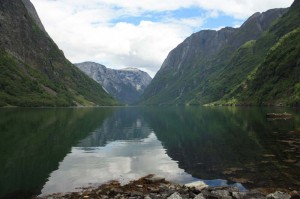
Naeroy Fjord
I think of him and of his wife, Locina Andersdatter, and how brave they must have been to leave their families, cross the Atlantic, knowing there would never be any coming back, not for them anyway, and enter a world as foreign as is Norway sometimes to me. Yet what it must have been to see that black soil of southwest Minnesota and the endless flatness. No, not beautiful as was the place where they were born, which must be one of the most beautiful places on earth, but rich, as rich as anything they ever could have imagined even from all the letters that came across the water claiming here was a land where all men had a chance. No mountains, no cliffs, no rocks—just acre after shimmering acre of flat ground rife with some of the world’s most fertile soil and waiting for a willing man and a willing woman to take a plow to it, carve it open, and unleash the generations that would follow, each one standing a little higher than the last.
And today, today perhaps, I thought, as I lay blinking into the silver light streaming in the window over the bed, staring quietly at the steel and shadow dappled walls of the fjord walls outside, will be the day when I can stand before my great-great-great grandfather’s grave and say, “Thank you for sending your son across the sea.”
Stay tuned for a full recounting of my 24-hour road trip through the fjord country of west-central Norway, including visiting the Boyabreen Glacier, Romsdals Fjord, the Trollstigen, Geiranger Fjord, the stave kirke at Lom, Jotunheim, the Tindevegan, and famous Laerdal Tunnel. Think it can’t be done? You just haven’t had enough caffeine….
Posted by Deborah Huso on Nov 9, 2010 in
Travel Archives 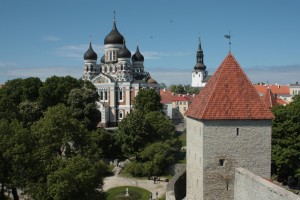
Andrew Nevsky Cathedral and Town Wall
While I was fully prepared to be amazed and delighted by the architecture of Northern Europe’s oldest capitals when I toured along the Baltic last spring (spending a day strolling the narrow streets of Stockholm’s Gamle Stan and then enduring the crush of crowds in St. Petersburg, Russia), I was pleasantly intrigued to find another often overlooked architectural gem on this Baltic tour–Tallinn, Estonia. If you’re old enough to have some sense of the history of the Baltic States (Estonia, Latvia, and Lithuania), this may perhaps surprise you. Likely you associate their names with the gray and concrete world of so many former Soviet bloc countries. But Estonia, not unlike some of her former Soviet Socialist Republic neighbors (the Ukraine comes to mind) has slowly regained her identity (and prosperity) in a re-imagined Eastern Europe where capitalism, not communism, rules the day and rules it beautifully.
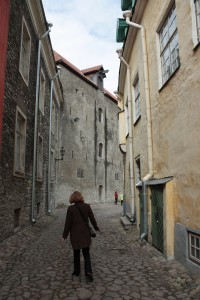
Walking the streets of Tallinn's Old City
Less crowded by far than Stockholm, which draws throngs of visitors each year to its exceedingly well-preserved Old Town, Tallinn is a destination in her own right…and significantly cheaper. Rich in Nordic and Germanic culture, this capital city on the Gulf of Finland has one of the best preserved 12th and 13th century city centers in Europe. And being rather compact, it’s easy to explore on foot in a day. But make sure you’re in good shape because to fully appreciate all Tallinn’s architecture has to offer, you must be willing to climb lots and lots of steps.
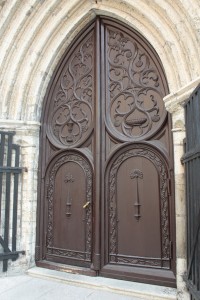
Sanctuary door at Oleviste Church
The climbing began for me in the tower of Oleviste Church, once the tallest building in the world, where I mounted 258 steps for amazing views of the Old Town, including the city’s dozen or more defense towers, numerous delicate church spires, and tiled rooftops. You can gain similar views (though not quite as grand) by climbing the Town Hall Tower, where some of the stone risers are more than foot high, making for quite a workout to reach the top of the belfry tower at 34 meters.
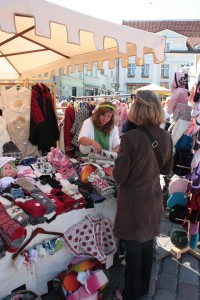
Shopping in Town Hall Square
One of the best things about Tallinn, however, is how wonderfully inexpensive it is compared to its Scandinavian neighbors. Street vendors will sell you gorgeous handwoven linens for a quarter the price you’ll find them in Norway or Sweden, and they’re every bit as lovely. And the locals absolutely adore tourists–the idea of expended effort equaling financial gain is refreshingly alive and well. Don’t hesitate to haggle for that fine wool cape or fur-lined cap. A fine lunch can be had here as well at places like the Saiakangi Kohvik Cafe for little more than $10 USD a person with scrumptious eats like smoked salmon and lamb open-faced sandwiches with beer followed up by cake-coated pastries with chocolate cream centers.
You can read more about my adventures in Tallinn at Military Officer magazine online as well as gain additional insights for traveling internationally on a budget in my article “Travel Abroad — For Less.”
Posted by Deborah Huso on Nov 6, 2010 in
Writer Rants Having worked for many years as a public relations consultant myself (until the 11 p.m. calls from newspaper reporters and consistently overdue payments of too many clients eventually inspired me to give up the ghost), I’m all too well aware of the hazards of the business, how the slightest misstep can blacklist you and your client…for life. And having worked both sides of this media table, I find myself not infrequently amazed at the number of untrained people out there calling themselves “publicists.” It is no wonder the profession has the reputation of being the purview of former cheerleaders who have consumed too many energy drinks.
But lest I offend the couple dozen public relations professionals who regularly and promptly supply me with expert sources in deadline pinches (you know who you are–God bless you!), let me say there are plenty of PR folks who know exactly what they’re doing–those who are able to walk the fine line between promoting their clients and understanding that journalists do not exist for the purpose of providing upbeat editorial coverage of hair tonic and exercise videos. Nor do they berate me by e-mail for failing to interview their company CEO when he failed to call before my deadline or tell me how unreasonable I am to expect them to locate the world’s foremost brain surgeon in two hours. Trust me, my editors would not understand or empathize if I attempted to explain it was 2 a.m. in Australia, and Dr. So-and-So just isn’t awake right now.
So for those of you who are scratching your heads and wondering just how to do this tricky job of PR, here are some tips:
- When I call you for an interview source and tell you I’m on two-hour deadline, please don’t whine about how impossible it is for you to work within that ridiculous timeline. How do you think I feel? Either say you can help or you can’t, and IF you say you CAN, then please do it. Don’t string me along for 118 minutes only to finally tell me getting an interview with your client is hopeless.
- Understand you are not the only boxer in the ring. Chances are good, you’re not the only person I’m calling for comment on whether or not eating a can of tuna a day is bad for your health. Realize the fastest pigeon wins the race, and if two other doctors call me back before yours does, bow out gracefully, and ask me to call you again sometime. Chances are, I will. Throw a raging fit, and you’ll never hear from me again.
- Once your happy client has been featured in an article of mine, please don’t pelt me daily with irrelevant pitches by e-mail. Nothing will inspire me to associate your name with the “delete” button faster.
- Don’t even think of calling me on the phone unless you are responding to a direct request from me for a source. The last thing I need when I’m on two-hour deadline is to hear your pitch on “the secret life of the penis” for 15 minutes. I don’t care if you are Dr. Oz or his best friend. I just really don’t have time. If you think what you have to say is really and truly that important and within my realm of typical editorial coverage, send me an e-mail, and if you don’t hear back from me, you can probably assume your hunch was wrong.
- Understand relationships are everything. Establish a good one with me, and I’ll think of you every time I need an expert.
- Do not ever call my home phone number. If you have the misfortune of getting me on the phone, you will not only be blacklisted for life, but you’ll probably experience a side of my personality I reserve exclusively for telemarketers, excessively nosy neighbors, and meddling relatives.
Please note that the above rules apply in almost any media coverage situation with almost any journalist. If you abide by them (and can simultaneously accomplish the not especially easy task of getting your client to abide by them as well), you’ll find yourself outpacing your peers in the field by leaps and bounds. So next time you get a grumpy reporter on the phone, ask yourself (before you take offense), if you’ve followed these six rules. Chances are, you haven’t.
Posted by Deborah Huso on Nov 5, 2010 in
Travel Archives Moon Blue Ridge & Smoky Mountains
Dan Smith, editor of Valley Business Front, reviewed Moon Blue Ridge and Smoky Mountains (Avalon Travel, 2010) in the October issue of the magazine. I had the pleasure of making Dan’s acquaintance at a writer’s conference last spring. See what he has to say about my new book on page 52 of the digital version of Valley Business Front.
Pick up your own copy of Moon Blue Ridge and Smoky Mountains at your favorite bookseller, or purchase a copy online.
Posted by Deborah Huso on Nov 3, 2010 in
Writer Rants Perhaps this headline strikes you as a little odd coming from someone who earns her bread as a journalist. But it’s precisely because I’m a journalist that I feel as I do. I’m always certain nothing good is coming when a friend or relative claims earnestly, “But I saw it on CNN!” As if that makes it true.
Sloppy journalism is an unfortunate norm, driven by a number of factors–the desire to be the first to get a news story on the air or on the web, the sheer insanity of deadlines that require one to report on complex topics with very little preparation or research beforehand, the dumbing down of the media world in an age when any Tom Fool can get on the Internet and claim fiction as fact…. The list goes on.
And while I’ve long been aware of just how unreliable most information the media puts out there is, every so often it hits home really hard. Earlier today, a public relations contact of mine gleefully pointed out to me that a recent article of mine had been quoted and used as a source in an article in TIME magazine. Now the uninitiated may all think TIME magazine like BBC News is above reproach. I beg to differ. The fact that they used something I wrote as a source is proof positive that they’re as guilty of sloppy journalism as anyone.
Why?
Because the article in question was one I wrote on a two-hour deadline, following a poor night of sleep, a major scrambling for interviews with experts, all while multi-tasking on two other projects at the same time. I’m not saying my article is inaccurate, but I will say I was mortified to see it used as a source by someone else. Suddenly, the work of a single, over-worked, tired out, frazzled journalist is becoming the law of the land. Do you see where I’m going with this?
On any given day, I conduct half a dozen or more interviews and write three to four articles, and that’s just between the hours of 8:30 a.m. and 5 p.m. Even the finest multi-tasker has statistics stacked against her. With that much content pouring out of my office each day, something somewhere is going to be wrong.
How often have I interviewed experts on breaking news stories only to have them rant about how that reporter they talked to at some competing news organization got it all wrong? It happens a lot, more than I care to think about. Many times when I’ve been asked to dig deeper into some amazing new story about how much healthier it is to eat a Big Mac than a boiled egg, I find it’s all hype. It’s not true. And there’s no story. But some reporter somewhere (either because his editor told him to or because he failed to do his homework) is out there claiming there is a story, and it’s all over the evening news, the Internet, and the front page of the next morning’s paper. These things frighten me.
They frighten me because, as a journalist, I know to take everything I hear, read, or see with a grain of salt. I know journalists are human, that they’re not only subject to make mistakes but that some of them will even make mistakes on purpose just for the sake of being the one to break a big story (whether it’s true or not). But does the average consumer of information know just how fallible journalists are? Or just how disturbingly sensationalist the media has become in the way it reports and presents the news? Probably not.
But you’ve been warned. The brave new world of journalism is not, in many instances, journalism at all. When news can be accessed 24/7, the news provider who gets the worm (i.e. the hits) is not the one who does the best reporting, but the one who writes the most intriguing headline (true or not) before someone else does.
Posted by Deborah Huso on Oct 21, 2010 in
Writer Rants I am in need of an experienced part-time writing and research assistant. You must have excellent writing skills as well as the ability to conduct online research, meaning you know what’s reliable and what’s not. (We don’t use Wikipedia in this office.) You must also have a strong grasp of AP style, be comfortable talking on the phone, and calm under pressure. You must be willing to work in an environment of frequently tight deadlines and be able to switch the direction of your work instantaneously without missing a beat. I require someone who is extremely organized and is proficient in the use of Microsoft Word, Excel, and Outlook and who has some skills in PhotoShop.
Some expertise in health, business, real estate, home building, and public policy issues is preferred but not necessary. The ability to work independently is essential, and you must be highly self-motivated.
If you want to learn how to be a successful journalist in an ever changing media landscape and you’re not afraid of hard work, this job is for you.
I will consider a telecommuter. Please e-mail a cover letter, resume, three writing samples, three professional references, and compensation requirements to writer@drhuso.com.